
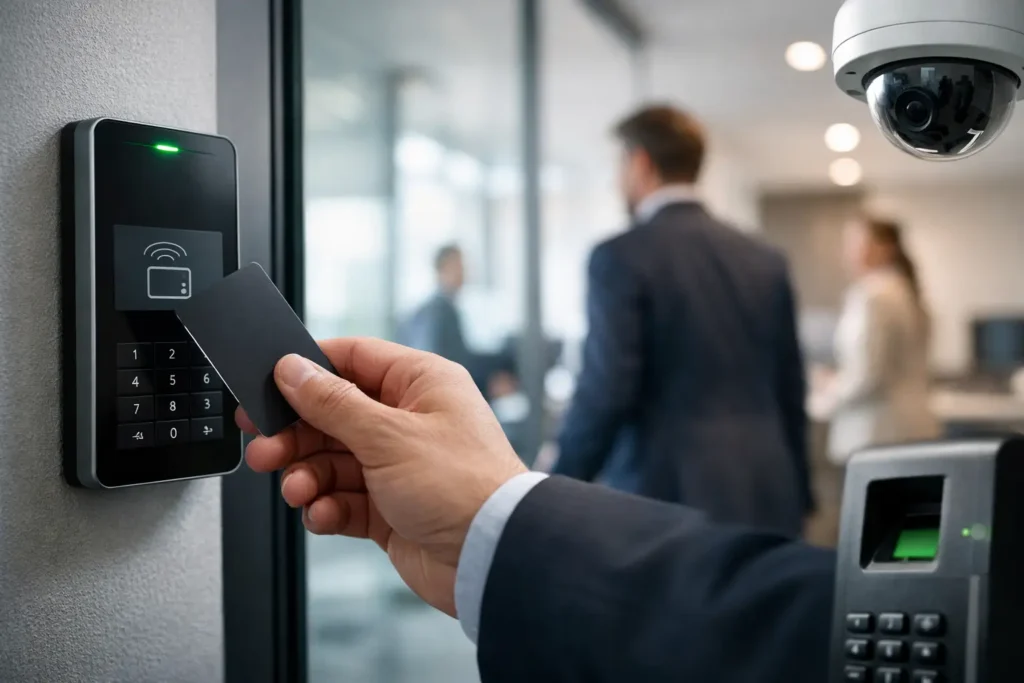
A rear entrance propped open for a delivery, a former employee whose key was never returned, or an unlocked records room can create a security problem long before anyone notices it. The question, “What is an access control system?” matters because it addresses those everyday gaps with a clear, manageable way to control who can enter a business and when.
An access control system uses credentials, door hardware, and management software to allow or deny entry to a defined area. Instead of relying only on mechanical keys, a business can assign access through key cards, fobs, mobile credentials, PIN codes, or biometric readers. Each access event can be recorded, helping leaders protect people, property, and sensitive information while reducing the burden of key management.
What Is an Access Control System?
At its core, an access control system makes a decision at the door. An employee presents a credential to a reader. The reader sends that information to a controller or cloud-based platform, which checks the person’s permissions. If the credential is valid for that door at that time, the system releases the lock. If it is not valid, the door remains secured.
This process happens in seconds, but the value is much larger than the transaction itself. Facility managers can issue access for an employee’s role, restrict visitors to approved areas, set schedules for certain doors, and remove access immediately when someone leaves the organization. That is a meaningful improvement over collecting keys, changing locks, and hoping every copy has been returned.
Access control is also not limited to exterior doors. Many businesses use it to secure offices, server rooms, inventory areas, pharmacy storage, records rooms, maintenance spaces, and shared tenant entrances. The right design depends on the building, the people using it, and the level of protection required for each area.
How an Access Control System Works
A complete system has several parts that must work together correctly. The credential is what a person uses to request entry. It may be a proximity card, key fob, mobile phone, PIN, or fingerprint. The reader recognizes the credential and communicates with the system controller.
The controller is the decision point. It receives the request, compares it against programmed permissions, and tells the electronic locking hardware whether to release the door. Door position switches and request-to-exit devices provide additional information, such as whether a door is open or whether someone is exiting safely.
The management platform gives authorized administrators a place to add users, assign doors, set schedules, review activity, and respond to changes. Some systems are managed through software installed on a local server, while others use a secure cloud-based platform. Cloud management can be convenient for multi-site organizations and remote administration, but a local system may be preferred when an organization has specific network, compliance, or operational requirements.
A properly designed installation also considers power, cabling, life safety, and network reliability. Electronic locks and readers are only as dependable as the infrastructure behind them. This is why standards-based wiring, coordinated door hardware, and experienced installation matter as much as the software interface.
Access Control Credentials and Door Hardware
The best credential is not always the newest one. It should fit the way people work and the level of risk at the opening. A small office with a few employees may be well served by cards or fobs. A medical office, warehouse, or multi-site business may benefit from mobile credentials and more detailed reporting. High-security areas may require two forms of verification, such as a card plus a PIN.
Common credential options include:
- Key cards and fobs, which are familiar, affordable, and easy to replace.
- Mobile credentials, which allow authorized users to use a smartphone instead of carrying another card.
- PIN codes, which can be useful at select doors but should be changed when access needs change.
- Biometric credentials, such as fingerprint readers, which can add verification for restricted areas.
Door hardware must match the opening and how it is used. Electric strikes are often used on certain framed doors because they release the latch when authorized. Magnetic locks are common on some glass, aluminum, and commercial openings. Electrified lever sets, panic hardware, and gate operators may be appropriate in other locations.
There are trade-offs. A credential may be convenient but easier to share. A biometric reader can increase verification but may introduce privacy concerns and require more careful user enrollment. A system should support safe emergency egress and comply with applicable fire, building, and accessibility requirements. Security should never prevent people from exiting safely.
Why Businesses Move Beyond Traditional Keys
Mechanical keys still have a place, but they offer limited control once they are distributed. A business may not know who has a copy, which doors a person can access, or whether a key was used after hours. Re-keying after employee turnover can also become expensive and disruptive.
Access control provides practical operational advantages. Permissions can be changed without replacing locks. A manager can grant a contractor temporary access to a specific entrance during scheduled work hours. An operations team can set a door to unlock automatically during business hours and secure itself after closing. If a card or phone is lost, its access can be disabled rather than requiring a lock change.
Activity records can help investigate incidents, confirm that a door was accessed, or identify repeated denied-entry attempts. These records are not a substitute for good supervision or clear policies, but they provide useful information when questions arise.
For organizations with multiple locations, centralized access management can reduce the need for separate processes at every facility. The benefit is not simply more technology. It is better consistency across offices, warehouses, clinics, campuses, and tenant spaces.
Access Control and Other Security Systems
Access control is most effective when it supports the broader security and communications environment. A camera positioned at a controlled entrance can provide visual context for an access event. An intercom system can allow staff to verify a visitor before remotely granting entry. Alarm systems can protect doors or areas when the facility is closed.
Integration should be purposeful. Connecting every available system may add cost and administrative complexity without solving a real problem. For example, a small office may only need controlled entry and a video doorbell-style intercom at one entrance. A larger facility may need coordinated access, surveillance, alarm monitoring, visitor management, and network connectivity across several buildings.
The network deserves particular attention. Many modern access systems depend on network communication for administration, reporting, and integrations. Planning for secure network connections, appropriate cable pathways, power backup, and service access helps prevent a security system from becoming an operational weak point.
Planning the Right System for Your Facility
The right starting point is a walk-through of the facility and its daily routines. Identify the entrances people use, the areas that require restricted access, the number of users, visitor patterns, delivery needs, and existing door conditions. A well-used loading entrance may need a different solution than a low-traffic executive office or a records storage room.
It also helps to define who will administer the system. Some businesses want a local manager to add cards and run simple reports. Others want IT, facilities, or a corporate security team to manage users across locations. Clear administration keeps the system useful after installation rather than leaving it unchanged as people and roles change.
Budget decisions should account for more than initial hardware. Consider credential replacement, software licensing where applicable, network needs, battery backup, future doors, and ongoing service. Choosing a system that can expand is often sensible, but paying for complex features that no one will use is not.
For commercial customers in Central Alabama, a single experienced provider can simplify coordination between access control, structured cabling, video surveillance, alarm systems, and communications infrastructure. Comtex designs and supports connected systems with the installation quality and local accountability businesses need for daily operations.
The most useful access control system is one that fits the building and the people inside it. When access rules are clear, doors operate reliably, and support is available when conditions change, security becomes part of normal business operations rather than a constant source of disruption.