
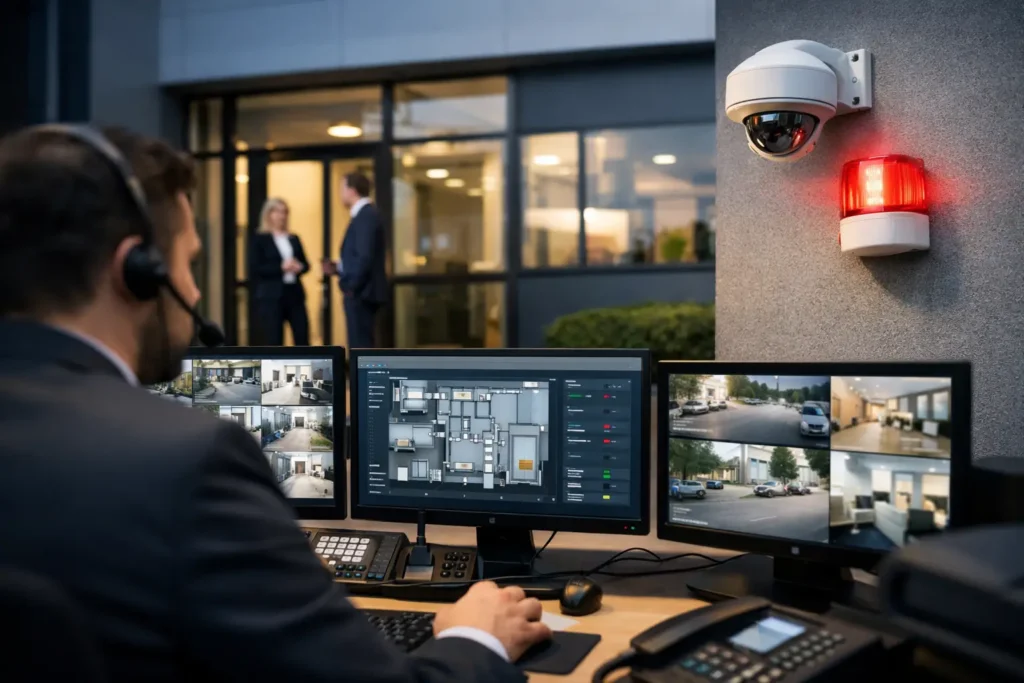
A break-in alarm only has value when someone receives the signal, understands what it means, and follows the right response process. Alarm systems monitoring services give businesses that coverage when a facility is closed, a manager is unavailable, or an event occurs faster than an employee can react. For commercial properties in Central Alabama, monitoring turns a security system from an on-site device into an active part of business continuity.
That distinction matters. A local alarm may sound loudly enough to discourage an intruder, but it cannot call a designated contact, dispatch authorities according to the established protocol, or document the event. Professional monitoring adds accountability at the moment when a business is most vulnerable.
What Alarm Monitoring Does for a Business
An alarm system uses sensors, control panels, and communications equipment to detect a condition such as an unauthorized door opening, motion after hours, glass breakage, or a fire-related event. Monitoring is the service that receives the system’s signal at a central station and initiates the predefined response.
The response should reflect the facility and the type of event. A warehouse with loading docks has different risks than a medical office, financial institution, school, or multi-tenant commercial building. One site may need key personnel contacted first for a non-emergency alarm. Another may require immediate dispatch based on its procedures, hours, and insurance requirements.
This is why monitoring should not be treated as a generic add-on. The communication path, contact list, alarm priorities, access procedures, and system design all affect whether the service supports operations when it is needed.
For a business owner or facility manager, the practical benefit is simple: a security event does not depend on one employee seeing a text message at 2:00 a.m. The system has a defined path for escalation, even when the building is empty.
Why Professional Monitoring Is Different From Self-Monitoring
Self-monitoring can send alerts to a phone or email account. For some low-risk applications, that may be useful as a supplemental notification. It is not the same as having trained personnel available to receive signals and follow a response procedure around the clock.
A business may have owners traveling, supervisors working different shifts, or a team that cannot safely investigate an after-hours alarm. Phone notifications can also be missed because of poor reception, a depleted battery, a device setting, or simple human delay. Professional monitoring provides a structured response process rather than placing the entire burden on an individual.
There is also a documentation benefit. Businesses often need to know when an alarm occurred, which zone activated, who was contacted, and what action was taken. Clear alarm records can help managers investigate incidents, coordinate with law enforcement, and identify recurring issues such as a door that is not being secured correctly.
Professional monitoring does not eliminate every false alarm or guarantee that a criminal event will not occur. It does provide a consistent process for receiving and acting on signals. That reliability is especially valuable for facilities that have inventory, sensitive records, equipment, multiple access points, or employees working outside standard business hours.
Alarm Systems Monitoring Services Need a Reliable Signal Path
The monitoring center can only respond if it receives the alarm signal. The connection between a control panel and monitoring service deserves the same attention as the sensors on doors and windows.
Traditional phone lines were once common for alarm communications. Many businesses now rely on cellular, internet-based, or dual-path communications. Each option has trade-offs. Internet communication can be efficient where network service is dependable, while cellular communication may continue operating during a local internet interruption. A dual-path configuration provides an additional layer of continuity by using more than one communication method.
The right choice depends on the site, available infrastructure, the importance of the facility, and the level of redundancy the business requires. A small office with limited after-hours activity may have different needs than a multi-site organization, a property with high-value assets, or a facility where a communications interruption creates a significant exposure.
This is also where integrated technology matters. Network changes, router replacements, carrier transitions, and power issues can affect alarm communication. When the provider installing the security system also understands the site’s cabling, network, internet, and phone environment, potential gaps are easier to identify before they become a problem.
Power Backup Is Part of the Plan
An alarm panel and its communications equipment need backup power to operate during an outage. Battery condition, equipment age, and proper installation all influence how long a system can continue functioning without normal electrical service.
Routine testing should confirm that the panel communicates with the monitoring center, the backup power is functioning, and required contacts remain current. A monitored system that has not been tested or updated can create a false sense of security.
Choosing the Right Response Plan
A monitoring plan should be built around the way the business actually operates. Before selecting services, decision-makers should consider what needs protection, when the building is occupied, who has authority to respond, and which events need immediate escalation.
For example, a retail location may prioritize intrusion detection at exterior doors, stockrooms, and cash-handling areas. An office building may focus on after-hours access points and restricted spaces. A manufacturing or distribution site may need broader perimeter coverage, loading-area protection, and procedures that account for early or late shifts.
The response plan should also distinguish among alarm types. An unauthorized entry, a panic alarm, a supervisory condition, and a low battery signal should not necessarily follow the same notification process. Establishing these rules in advance helps avoid confusion during an actual event.
Contact lists deserve particular attention. Businesses change managers, employees, vendors, and after-hours responsibilities regularly. An outdated list can delay decision-making or result in calls to people who no longer have access to the property. Review contacts after staffing changes and at regular intervals, especially for organizations with multiple locations.
Integration Creates Better Visibility
Alarm monitoring is most effective when it works alongside the other systems that support facility security. Access control can show who used a credential at a door before or after an alarm. Video surveillance can provide visual information for an authorized manager reviewing an event. Intercom systems can help teams manage visitors and deliveries at controlled entrances.
These systems do not need to be overcomplicated to be useful. The goal is to give the business clearer information and stronger control over its facilities. A monitored intrusion alarm may identify an event at a specific door, while an associated camera view can help the business understand what happened. Access control records may reveal whether the opening was authorized or whether a door was left unsecured.
Integration also simplifies vendor management. When security, structured wiring, communications, and network infrastructure are planned together, businesses have fewer handoffs between providers and a clearer point of accountability. For Central Alabama organizations, Comtex can design and support connected systems that align security needs with the operational technology already in place.
Installation Quality Affects Monitoring Performance
Monitoring cannot compensate for poorly placed devices, unreliable wiring, or a panel that does not match the facility’s needs. A sound security design starts with a site assessment: entry points, traffic patterns, existing infrastructure, building layout, valuable assets, and the way employees use the property.
Commercial installations should be completed with attention to applicable standards, clean cable management, proper device placement, and serviceability. A sensor should protect a real risk, not simply fill a line item. Equipment should be accessible for testing and maintenance, while remaining protected from accidental damage or interference.
False alarms are another reason installation and configuration matter. They can disrupt staff, create unnecessary dispatches, and lead employees to dismiss real alerts. Many false alarms can be reduced through correct device selection, proper adjustment, training for authorized users, and clear opening and closing procedures.
A practical system also accounts for growth. If a business expects to add offices, expand a warehouse, lease another suite, or centralize management of several locations, the security design should leave room for that change. Planning for expansion is usually more efficient than rebuilding the system after the fact.
Questions to Ask Before Selecting a Monitoring Provider
The best provider is not simply the one offering the lowest monthly rate. Businesses should understand how alarms are communicated, what happens after a signal is received, and who supports the system when conditions change.
Ask whether the provider can support the full system lifecycle, from site assessment and installation through monitoring, testing, service requests, and future upgrades. Confirm the available communication options and whether backup paths are appropriate for the site. Review how contacts and response instructions are managed, and ask what service process applies when a panel, sensor, or communication device needs attention.
It is equally useful to discuss the systems already installed at the property. An existing alarm system may be upgradeable, but not every older panel supports current communication methods or integration needs. An honest evaluation can help a business decide whether targeted improvements are sufficient or whether a replacement will provide better long-term reliability.
A monitored alarm system is not just an expense associated with a building. It is a planned response to the moments when the people responsible for the business cannot be on-site. With the right design, communication path, and support partner, security monitoring becomes one more dependable part of keeping the operation connected and protected.