
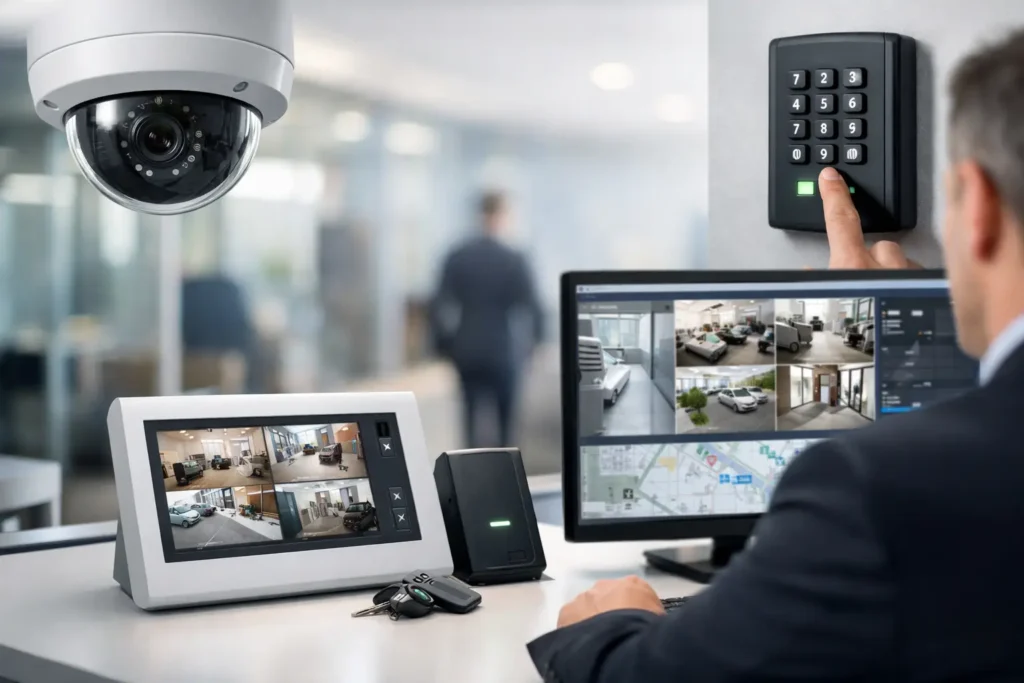
A door forced open after hours is rarely just an alarm event. It can affect employee safety, inventory, insurance documentation, tenant confidence, and the next morning’s operations. Integrated business security systems help organizations see the full event instead of sorting through separate apps, disconnected equipment, and calls to multiple vendors.
For businesses across Central Alabama, the objective is practical: know who entered, what happened, where it happened, and how to respond. Bringing access control, video surveillance, intrusion alarms, intercoms, and network infrastructure into a coordinated design makes that possible. It also makes day-to-day security easier to manage as facilities, teams, and operating hours change. Comtex / Furlongs Security can help you with all of that. Call us at 334-271-4000 or 205-871-3000. You may also want to check the website at www.COMTEX.org for more information or BLOG articles to help you.
What Makes a Security System Integrated?
An integrated system does more than place several security products in the same building. Its components are designed to share information and support a coordinated response.
For example, an access control event at a side entrance can be associated with video from the nearby camera. If an alarm is triggered, authorized personnel may be able to review the relevant camera view quickly rather than searching through hours of footage. An intercom at a controlled entrance can support visitor verification before a door is released.
The result is better context. A facility manager does not have to guess whether a door was propped open, a credential was used after normal hours, or an alarm was caused by an authorized employee. The system can provide a clearer record of the activity.
Integration also depends on the underlying network and cabling. Cameras, controllers, access readers, wireless devices, and communications equipment need reliable connectivity and properly planned power. A weak network design can limit a security system that otherwise looks strong on paper.
Why Separate Systems Create Operational Gaps
Many businesses add security technology over time. A burglary alarm may come first, followed by cameras after an incident, then card access when key control becomes difficult. Each purchase can solve an immediate problem, but separate systems often create long-term friction.
The most common issue is limited visibility. An operations leader may receive an alarm notification but have no simple way to review the associated video. A manager may deactivate a former employee’s access credential but still need to remember a separate process for gates, alarm codes, or shared systems.
Vendor management can become another burden. When the cabling contractor, alarm provider, camera company, network consultant, and telephone vendor all work independently, resolving a problem can take longer than it should. The question becomes whether the issue is the device, the wiring, the network, the configuration, or the service provider.
A coordinated approach does not eliminate every service need, and some existing equipment may need to remain in place during a phased upgrade. It does, however, create a plan for how systems will work together rather than allowing technology to accumulate without a clear operating model.
The Core Parts of Integrated Business Security Systems
The right configuration depends on the facility, risk profile, staffing model, and budget. A medical office, warehouse, school-adjacent property, retail location, and multi-tenant office building do not have the same security requirements. Still, most integrated business security systems are built around a few essential functions.
Access Control for Better Entry Management
Access control replaces the uncertainty of traditional keys with managed credentials and documented entry activity. Authorized users can enter through cards, fobs, mobile credentials, or other approved methods, while administrators can adjust access by person, door, schedule, or location.
This is particularly useful when employees leave, vendors need temporary access, or a business has multiple facilities. Instead of collecting keys and wondering whether duplicates exist, a credential can be changed or removed from the system.
Access control is not only for exterior doors. It can help protect server rooms, records storage, inventory areas, executive offices, maintenance spaces, and other sensitive locations. The appropriate level of control depends on the purpose of the room and the people who need access to it.
Video Surveillance That Supports Decisions
Cameras are most valuable when they are placed to answer real operational questions. That may mean documenting deliveries, monitoring customer entrances, viewing parking areas, protecting loading docks, or verifying activity at a controlled door.
Camera selection matters. A wide-angle camera can provide general awareness in a lobby, while a targeted view may be needed to identify activity at a cash handling area or vehicle gate. Lighting, mounting height, viewing distance, retention requirements, and network capacity all affect performance.
Video should be planned alongside access control and alarm events. A camera that captures an entrance but cannot be easily associated with door activity leaves useful information disconnected. Properly designed integration helps staff move from an event to supporting footage without unnecessary delay.
Alarm Systems for After-Hours Protection
Intrusion detection remains a critical layer of business security. Door contacts, motion detection, glass-break sensors, panic devices, and other components can help identify unauthorized entry or urgent situations.
An alarm system needs careful design, not simply maximum coverage. Excessive false alarms can interrupt operations and reduce confidence in the system. A walkthrough of the property should account for entry routines, pets or wildlife where relevant, environmental conditions, employee traffic, and areas that need special protection.
When alarm activity is connected to access and video information, response becomes more informed. An authorized employee arriving early may create a different situation than an alarm event at a door with no associated credential activity.
Intercoms and Communications at the Entry Point
For many facilities, the front door is both a customer welcome point and a security decision point. Intercom systems allow staff to communicate with visitors before granting access, which is useful for offices, healthcare facilities, schools, warehouses, gated properties, and controlled service areas.
The best choice depends on how visitors arrive and who responds. A receptionist may need desktop communication, while a warehouse supervisor may need calls routed to a mobile device or designated station. Integrating entry communication with access control creates a more controlled and professional visitor experience.
Start With the Building and the Workflow
Security planning should begin with how the business actually operates. A floor plan matters, but so do employee arrival times, delivery patterns, public access, shift changes, cash handling, remote work, and emergency procedures.
A thoughtful assessment considers questions such as: Which entrances are used every day? Where do visitors wait? Which areas contain equipment, records, or inventory? Who needs access after hours? What happens when an employee is terminated? Where are cameras needed to support an alarm response?
For multi-site organizations, consistency is often as valuable as added features. Standardizing credential policies, camera coverage expectations, naming conventions, and support procedures can reduce confusion across locations. At the same time, each site may require different equipment based on its layout and risk level.
Design the Network as Part of the Security Plan
Security equipment relies on the network more than many organizations realize. Video cameras can require significant bandwidth and storage. Access control panels need dependable communications. Remote viewing and cloud-connected services depend on stable internet service and secure configuration.
That is why structured cabling, switches, wireless coverage, power planning, and internet reliability should be considered early. Installing a camera without confirming cable paths, power availability, and network capacity can lead to avoidable compromises in placement or performance.
There are trade-offs to consider. Cloud-managed systems can simplify remote access and reduce some on-site hardware needs, but they may create recurring costs and depend heavily on internet reliability. Local recording can provide greater control over stored video, but it requires sufficient equipment space, maintenance, and retention planning. The right approach depends on operational requirements, budget, and the level of internal IT support available.
Choose a Partner That Can Support the Full System
The installation is only one part of a business security investment. Equipment needs to be configured correctly, users need practical training, and the system needs a clear path for service when something changes or stops working.
A single accountable technology partner can simplify the process by coordinating cabling, network readiness, cameras, alarms, access control, intercoms, and related communications infrastructure. This approach reduces handoffs and helps ensure that one part of the project does not undermine another.
Comtex brings decades of Central Alabama experience to this work, combining standards-based installation with service and support for connected business systems. That local accountability matters when a facility expands, an office relocates, a reader fails, or a security concern needs attention quickly.
Before moving forward, ask prospective providers how they handle system design, documentation, user training, monitoring, maintenance, and future expansion. A good solution should fit the building you have now while leaving room for the business you expect to become.
A well-planned security system should not add complexity to the workday. It should give your team clearer information, better control of the facility, and a dependable foundation for responding when security matters most.