
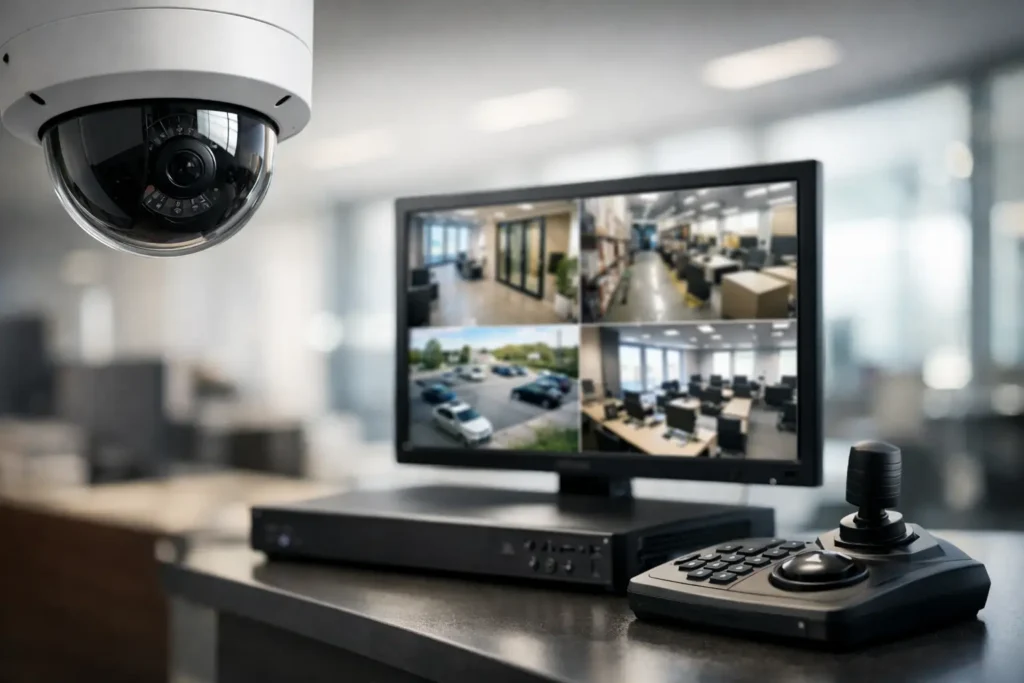
A camera mounted above a door is not a security strategy. Commercial video surveillance systems work when they give the right people useful visibility at the moments that matter: a delivery arrives after hours, an employee needs help in a parking area, inventory goes missing, or an incident requires a clear record of what happened. In addition, situational awareness for your business helps to provide better employee relations, customer service and security well designed systems.
For businesses in Central Alabama, the goal is not to place cameras everywhere. It is to build a system that supports daily operations, protects people and property, and remains dependable long after installation. That requires thoughtful design, reliable network infrastructure, and a support partner that understands how all the pieces work together. That company in Central Alabama is Comtex / Furlongs Security. Call 334-271-4000 for the Montgomery area and ask for Paul or Dale. For the Birmingham area, call 205-871-3000 and ask for Ty. Or you can visit www.COMTEX.org and www.FurlongsSecurity.com for more details and products to complete all of your security needs.
What a Business Surveillance System Should Accomplish
A commercial system should do more than record video. It should help a business see activity at critical locations, review events efficiently, and maintain evidence when questions arise. The right design may also discourage unauthorized access simply by making coverage visible and consistent.
Every facility has different pressure points. A retail location may need clear views of entrances, registers, stockrooms, and receiving areas. A manufacturing or warehouse operation may prioritize loading docks, perimeter gates, equipment areas, and employee entrances. Offices, churches, medical facilities, and multi-tenant properties often need a balanced approach that protects common areas without creating unnecessary coverage of private spaces.
That is why a camera count alone is a poor way to compare proposals. Two systems with the same number of cameras can deliver very different results depending on camera placement, image quality, lighting conditions, storage capacity, and the network supporting them.
Start With Risks, Not Camera Models
The best planning conversations begin with the facility itself. Walk the property with a clear understanding of where people enter, where assets move, which areas are difficult to supervise, and when the building is occupied. This gives the system a purpose before equipment is selected.
Consider the questions that tend to arise after an incident. Can management identify who entered through a certain door? Can a shipment be verified at the loading dock? Is there enough detail to distinguish a vehicle or review a transaction? Can authorized personnel check a remote site without driving across town?
Those answers guide camera selection and placement. A wide-angle camera may be appropriate for general awareness in a lobby or warehouse aisle, while a tighter view may be necessary at a gate, register, or door. More coverage is not always better. A poorly aimed high-resolution camera can be less useful than a properly positioned camera that captures the intended scene.
Plan for lighting and the physical environment
Lighting is one of the most overlooked parts of surveillance design. Backlit entrances, dark parking lots, reflective glass, bright loading bays, and changing weather can all affect usable video. Exterior cameras also need housings and mounting methods suited to the environment.
A site review should account for the view at different times of day, not only how it looks during an installation visit. The goal is a usable image when an event happens, whether that is at noon, after closing, or during a storm.
Commercial Video Surveillance Systems Depend on the Network
Modern IP cameras are network devices. They need dependable cabling, appropriate switching capacity, power, and secure configuration. When cameras are added without considering the underlying network, businesses can experience dropped connections, slow live viewing, inconsistent recording, or performance problems that affect other operational systems.
For a new facility, structured cabling can be planned alongside cameras, access control readers, wireless access points, and communications equipment. In an existing building, the design may need to work around construction limits, long cable paths, or areas where wireless connectivity is unreliable. Each situation calls for a practical approach, not a one-size-fits-all package.
Network separation and access controls also matter. Video traffic should be designed so it does not interfere with business-critical applications, and remote viewing should be limited to authorized users. A system is only useful when managers can access what they need without exposing sensitive video or creating unnecessary IT risk.
Storage Is a Business Decision
Recording retention is often treated as a technical detail until a business needs footage from three weeks ago and it is no longer available. Storage requirements depend on camera resolution, frame rate, recording schedule, scene activity, and the number of cameras. Continuous recording provides a complete timeline but requires more storage. Motion-based recording can reduce storage needs but must be tuned carefully to avoid missed activity or excessive false events.
There is no universal retention period that fits every organization. A small office may have different needs than a distribution center, a property management company, or a business with internal compliance requirements. The right question is: how far back does the organization reasonably need to investigate an event?
Storage should be sized with room for real-world conditions, including busy days, weather-related movement outdoors, and cameras added later. It is also worth deciding who can export footage, where those exports are kept, and how the business will preserve video after a significant incident.
Integrate Video With Access and Alarm Systems
Video becomes more valuable when it supports the rest of a facility’s security infrastructure. If an access control event occurs at a door, the corresponding camera view can help verify who entered and what took place. An alarm event can direct attention to a specific area rather than forcing staff to search through hours of recordings.
Integration does not mean every system must be complicated. It means systems should work together in ways that reduce response time and simplify operations. For a multi-site business, centralized visibility can help leadership oversee multiple facilities while local managers retain the access they need for daily responsibilities.
A single accountable provider can also make service easier. When video, network cabling, access control, and communications are handled in isolation, troubleshooting can turn into a series of vendor handoffs. Comtex helps commercial customers bring these connected systems together through coordinated design, installation, and ongoing service.
Build for Daily Use, Not Just for an Incident
A surveillance system has limited value if only one person knows how to use it. Managers and designated staff should understand how to view live video, search recorded footage, export clips, and report a problem. Clear user permissions are equally important. Not every employee needs access to every camera or every site.
Routine checks keep the system ready. Cameras can be blocked by landscaping, dust, construction changes, or shifting fixtures. Time settings, recording status, storage health, and remote access should be reviewed periodically. A camera that appears online is not necessarily recording the view a business needs.
It is also sensible to revisit the design after operational changes. A new entrance, expanded parking area, altered production line, or additional tenant can create blind spots that did not exist at installation. Security should adapt as the facility changes.
Choosing the Right Installation Partner
Commercial surveillance is not simply an equipment purchase. It is an installed business system that depends on design quality, standards-based wiring, secure configuration, and responsive service. The lowest initial quote can become expensive when coverage is incomplete, cable pathways are poorly planned, or the installer cannot support the system after commissioning.
Look for a partner that asks detailed questions about the property, network, operating hours, risks, and future plans. The provider should explain what each camera is intended to capture, how long video will be retained, and what happens when service is needed. That level of clarity helps business leaders make decisions based on operational value rather than specifications alone.
A well-planned system gives your team a clearer view of the places and events that affect your business. When a question arises, the right footage should be available, the system should be easy to use, and the support behind it should be close enough to respond.
Call 334-271-4000 for the Montgomery area and ask for Paul or Dale. For the Birmingham area, call 205-871-3000 and ask for Ty. Or you can visit www.COMTEX.org and www.FurlongsSecurity.com for more details and products to complete all of your security needs.