
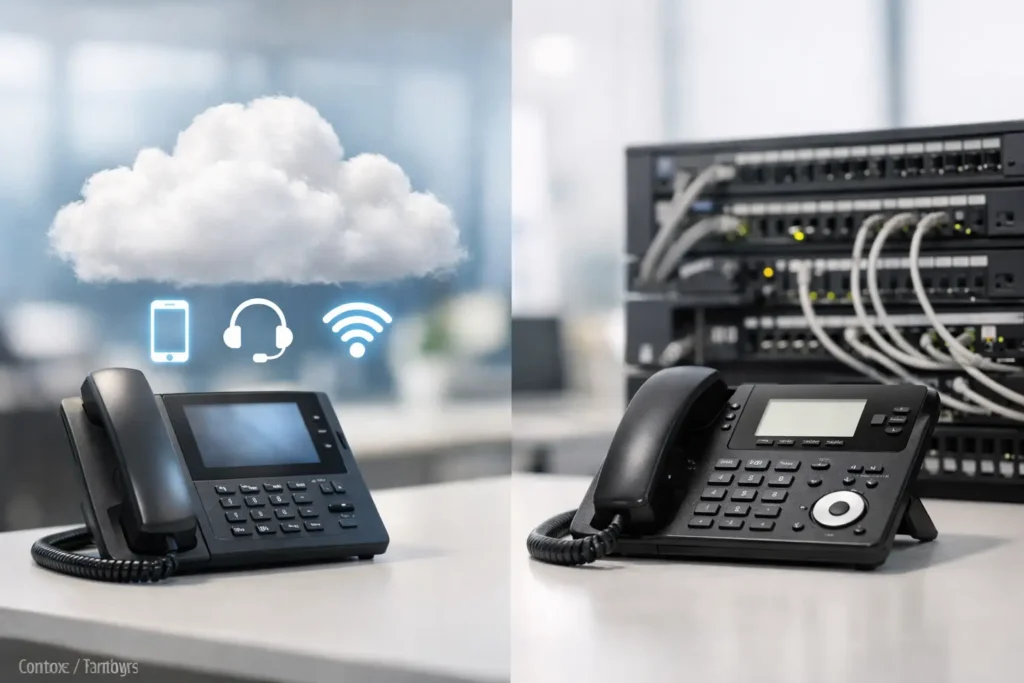
A missed call can mean a missed customer, delayed service, or an employee unable to reach help during an urgent situation. When comparing cloud phone systems (VOIP) vs PBX, the right choice is not simply about replacing desk phones. It is about choosing communications infrastructure that supports how your people work, how your facilities operate, and how your business handles interruptions.
For Central Alabama businesses, the decision often comes down to control, flexibility, budget, and the quality of the network behind the phones. Both options can provide dependable calling when they are properly designed and supported. The better fit depends on your location, staffing, growth plans, internet reliability, and operational requirements. Comtex has been selling and installing PBX and VOIP telephone systems since 1984 in Alabama. Call us at 334-271-4000 or 205-871-3000 for more information. www.COMTEX.org
What Is the Difference Between Cloud Phone Systems and PBX?
A cloud phone system delivers business calling through an internet connection. The service provider hosts the call-control platform in off-site data centers, while your business uses desk phones, mobile applications, computers, or a combination of all three. Features such as voicemail, auto attendants, call routing, extensions, and conferencing are managed through a web portal or provider support team.
A traditional private branch exchange, commonly called a PBX, is phone equipment installed at your facility. It connects internal extensions and routes calls to outside telephone lines or SIP trunks. Depending on the system, the PBX may use older analog or digital technology, modern IP phones, or a mix of both.
The terms can become confusing because some providers call their hosted service a “cloud PBX.” That is still a cloud phone system in practical terms: the call-control equipment is hosted off-site rather than maintained at your building. The key question is where the core system lives and who is responsible for maintaining it.
Cloud Phone Systems vs PBX: The Core Trade-Off
Cloud phone systems shift more responsibility to the provider. Your business generally pays a recurring service fee, relies on internet connectivity, and gains easier access to remote-work features and ongoing platform updates. A traditional PBX requires a larger investment in equipment and installation, but it gives the business more direct ownership and local control.
Neither model is automatically less expensive. A small office with limited calling needs may find that cloud service reduces upfront costs and administrative work. A larger operation with many extensions, stable facilities, and specialized call flows may find that an on-premises PBX offers a better long-term fit.
The most costly decision is often selecting a system based only on the monthly price. Phones are tied to customer service, emergency communications, front-desk operations, dispatch, scheduling, and coordination between locations. A low-priced service that does not fit the business can create daily friction that far exceeds the savings.
When a Cloud Phone System Makes Sense
Cloud phone systems are often a strong option for businesses with mobile employees, multiple locations, changing headcounts, or limited in-house IT resources. Employees can answer business calls from a desk phone, laptop, or mobile app while keeping one business number and extension. That flexibility can be valuable for sales teams, property managers, service organizations, and companies with staff who work across job sites.
Adding or changing users is usually straightforward. A business can assign a new extension, update call routing, or redirect calls to another location without installing major equipment at every site. Cloud platforms also commonly include features that once required separate hardware, such as automated attendants, call groups, voicemail-to-email, call recording, and video meetings.
Cloud service can also reduce the burden of maintaining an aging phone server. The provider handles core software updates and platform maintenance, while a qualified local technology partner can install phones, prepare the network, assist with configuration, and provide a clear point of contact when issues arise.
However, cloud calling depends on more than a good internet speed test. Voice traffic needs consistent bandwidth, low delay, and a properly configured network. If the internet connection drops, inbound and outbound calling may be affected unless the system has mobile failover, call forwarding, or a secondary connection in place.
When an On-Premises PBX Is the Better Fit
A traditional PBX can be the right choice for organizations that need close control over their phone environment, have unique equipment requirements, or operate from a stable primary facility. Certain healthcare, manufacturing, hospitality, education, and administrative environments may have specialized integrations, legacy devices, overhead paging, door intercoms, or existing wiring that influence the decision.
An on-premises system can keep internal calling functioning even when an outside service connection is disrupted, depending on the system design and available power. It may also support specific legacy lines, analog devices, or custom call handling that would be difficult or expensive to replace immediately.
The trade-off is responsibility. The business must plan for the PBX hardware, software licensing, maintenance, backup strategy, replacement parts, and eventual upgrades. If a server reaches end of life or a manufacturer ends support, the organization may face a significant modernization project. Local equipment also needs protected power, ventilation, secure access, and documented administration.
For some businesses, these responsibilities are acceptable because the control is valuable. For others, they create unnecessary risk and management overhead.
Reliability Depends on the Full System Design
Phone reliability is not determined by whether a platform is in the cloud or in a phone closet. It depends on the full path a call takes, including the carrier connection, structured cabling, network switches, electrical power, internet service, firewall configuration, and the support plan behind the system.
A cloud phone deployment should include adequate internet capacity and network equipment that can prioritize voice traffic. Power over Ethernet switches can supply desk phones, but those switches should be connected to a properly sized battery backup. For businesses where phone access is critical, a secondary internet connection or cellular failover can help keep communications available during an outage.
An on-premises PBX also requires a continuity plan. The system, carrier equipment, and network components need battery backup or generator support if calls must continue during a power interruption. It is also wise to plan for call forwarding to mobile devices or another location if the facility becomes inaccessible.
Emergency calling deserves special attention. The system should be configured so responders receive accurate location information, particularly in multi-floor facilities, warehouses, campuses, and multi-site organizations. This is not an item to leave until after installation. It should be part of the initial design and testing process.
Cost: Look Beyond the Monthly Bill
Cloud phone systems usually use a predictable per-user monthly cost. This can make budgeting easier, especially when equipment is purchased or financed separately. The recurring fee commonly includes the service platform, standard features, and updates, but businesses should understand what is included in calling plans, device support, setup, taxes, and advanced features.
A PBX may require a larger initial investment for equipment, installation, licensing, phones, and carrier connectivity. Over time, the monthly carrier costs may be lower than per-user cloud pricing in some situations. Yet the total cost also includes maintenance, upgrades, replacement hardware, and technical support.
When reviewing proposals, compare at least three years of total cost rather than focusing on the first invoice. Include cabling work, network upgrades, battery backup, phone replacement cycles, implementation labor, and the internal time required to manage the system. A clear scope makes it easier to compare options fairly.
Questions to Ask Before Choosing
The best phone system begins with an operational review, not a product brochure. Consider how calls arrive, where they need to go, and what happens when the normal plan fails. A few practical questions can clarify the direction quickly:
- Do employees need to answer business calls from home, job sites, or multiple offices?
- Is the current internet connection dependable enough for voice traffic, and is backup connectivity needed?
- Are there door intercoms, paging systems, alarm panels, fax lines, elevator phones, or other devices that must remain connected?
- Does the business need detailed call reporting, call recording, dispatch functions, or integrations with existing software?
- Who will manage day-to-day changes, and who will respond when service is disrupted?
These answers may point clearly toward cloud service, an on-premises PBX, or a phased approach that keeps certain local devices while modernizing employee communications.
Plan Phones as Part of Your Connected Infrastructure
A phone project is a good time to review the systems around it. Poorly labeled cabling, undersized network switches, weak wireless coverage, and unprotected power can undermine a new communications platform. Conversely, a well-planned installation can support phones, data, access control, surveillance, intercoms, and future expansion from a coordinated foundation.
For organizations managing several technology vendors, a single accountable partner can reduce confusion when an issue crosses system boundaries. Comtex helps commercial customers evaluate communications, network, and low-voltage infrastructure together so the finished system supports daily operations rather than creating another isolated technology project.
The right choice should make it easier for employees to reach customers, for managers to adapt to change, and for your business to continue communicating when conditions are less than ideal. Start with the way your operation actually works, then build the phone system and supporting infrastructure around that reality.