
Your first business phone system: a practical guide for Alabama offices
Upgrading phones before fall hiring can feel like several projects at once. Lines must port, menus must make sense, and users need to answer calls without friction on day one. The right plan brings these pieces together and avoids surprises.
This guide walks Alabama office managers and owners through mapping call flows, choosing between cloud and on-premises PBX, preparing the network, training by role, and building continuity. It also outlines how Comtex supports a clean cutover with site assessment and end-to-end service.
Start with call flow, not hardware
A dependable system starts with how calls should move, then translates that into features and programming. Define what success looks like before you touch phones.
- Identify entry points: main number, departmental lines, published direct-dials.
- Map daytime and after-hours handling: auto attendant, receptionist, call groups, voicemail.
- Document transfers: reception to billing, service to warehouse, nurse line to on-call.
- Plan special cases: holidays, severe weather, emergency dialing, bilingual menus.
- Note physical spaces: desks, reception, conference rooms, loading dock, gates, break rooms.
Write real call scenarios and test them during configuration. Keep the menu concise. Fewer options, clearer routing, faster answers.
Cloud vs on-premises PBX
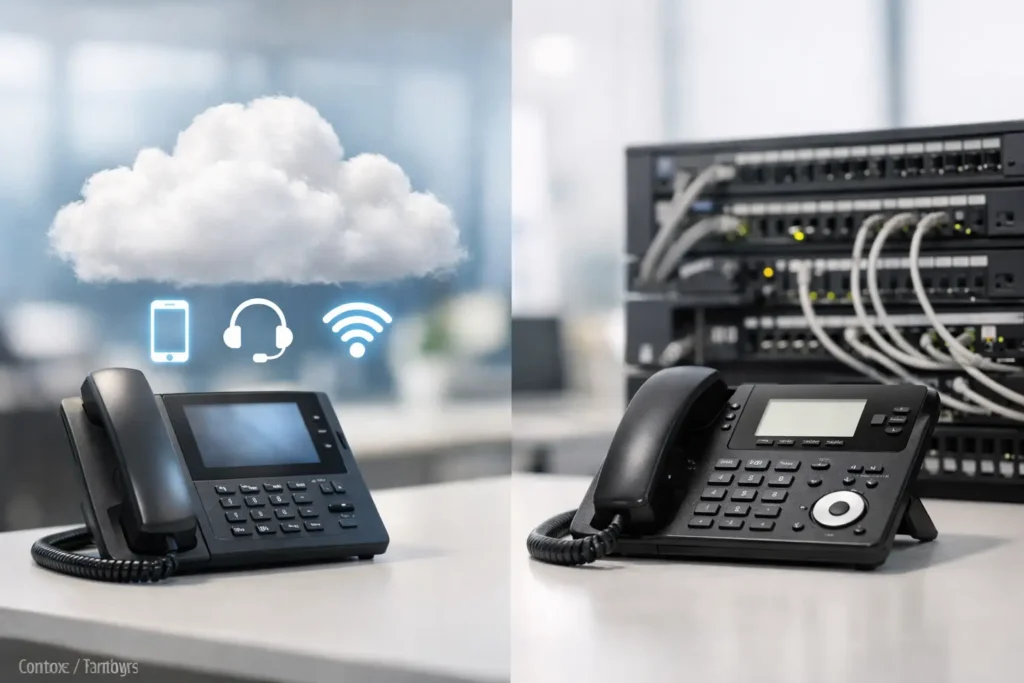
Both models are valid. The better fit depends on sites, staffing, compliance, and integration needs.
Cloud phone systems
- Strengths: flexible across locations and remote staff, quick to scale user counts, updates managed by the provider, mobile and softphone options, geographic redundancy.
- Consider if: you have multiple offices, hybrid work, seasonal hiring, or want minimal local telecom infrastructure.
On-premises or locally managed PBX
- Strengths: direct control of integrations and paging, predictable local performance, specific dial-plan rules, site-tailored failover options.
- Consider if: you have specialized paging, overhead speakers, plant-floor intercoms, or strict IT policies.
Many Alabama offices select cloud because it supports growth and remote access. On-premises remains common where paging and site-specific workflows drive requirements. Comtex helps compare both against your mapped call flow, user count, and continuity plan. For regional coverage and installation, see our page on Birmingham business phone systems.
Natural next step: review your user roles, numbers to port, and site conditions. Then select the model that best serves those needs rather than chasing a feature checklist.
Prepare your network for voice
Modern business telephony is IP-based. Voice rides the data network. Stability here determines call quality.
- Internet bandwidth: size for peak demand. Phones, cloud apps, video meetings, and backups compete.
- Switching and QoS: switches must support Power over Ethernet for IP phones where used, with Quality of Service to prioritize voice.
- Cabling: Cat6 in good condition is typical for offices. Replace damaged or mixed legacy runs. If you are adding drops or cleaning up pathways, Comtex provides Cat6 cabling in Montgomery and structured cabling in Birmingham to support phones, Wi-Fi, and security.
- LAN segmentation: keep phones on a voice VLAN where appropriate, with DHCP options and consistent addressing.
- Security and resiliency: managed firewall, current firmware, UPS on switches and routers so phones stay up during short power events.
Do not assume a VoIP desk phone will work perfectly by plugging it into any open port on a consumer router. It may register, but quality depends on the network behind it. A brief site assessment protects go-live.
Plan number porting and a clean cutover
Porting moves numbers from the current carrier to the new service. Lead times vary. Avoid downtime by aligning programming, testing, and training before the port date.
- Validate the customer service record with your existing carrier.
- Inventory all numbers: main, fax, DID ranges, published lines.
- Stage and test: call groups, voicemail to email, E911 records, after-hours routing.
- Pilot: verify real call scenarios with a small user group.
- Cutover: schedule during low-traffic hours, keep the old system reachable during the port window if possible.
- Post-cut: confirm inbound to all numbers, outbound caller ID, and voicemail delivery.
Comtex coordinates these steps and remains on site or on call during cutover to resolve issues quickly. For Montgomery and surrounding areas, explore our page on business telecom and internet services.
Train by role, then support
Training improves adoption. Make it role-based and practical.
- Reception: answering, assisted and blind transfers, parked calls, paging, directory search.
- Department users: forwarding rules, voicemail, mobile app or softphone if used, conference dialing.
- Managers and admins: call group membership, schedule changes, holiday menus, reporting.
Provide quick-reference guides and short refreshers after the first week. Comtex delivers role-based training and schedules follow-up so users can ask questions after real use. Ongoing support keeps the system aligned with staffing changes.
Build continuity into the design
Plan for events that disrupt normal operations.
- Internet outage: automatic call forwarding to mobile or alternate site, dual internet links where justified, cellular backup for key lines.
- Power loss: UPS for network gear, voicemail access off site, clear procedures for reception.
- Facility access issues or storms: reroute menus, play status messages, update after-hours destinations.
Cloud systems often make rerouting straightforward. On-premises systems can achieve similar outcomes with the right configuration and upstream carrier features. Document who can make changes and how to reach support after hours.
How Comtex delivers end-to-end results
- Site assessment: cabling condition, switching capacity, power for IP phones, paging and intercom needs, E911 records, building access.
- Design and build: call flow programming, device placement, integration with paging and doors, network readiness.
- Clean cutover: staged testing, number porting plan, on-site presence, immediate adjustments.
- Role-based training: reception, department users, managers, with follow-up.
- Ongoing support: moves, adds, changes, seasonal hiring updates, continuity checks.
If you are renovating or expanding, Comtex also designs structured cabling to align phones, Wi-Fi, cameras, and access control. Learn more about structured cabling in Birmingham or Cat6 cabling in Montgomery to support voice quality and future growth.
FAQs
What is the best phone system for a small business?
- The best system matches how your team handles calls. Many small offices choose a cloud platform for flexibility, easy scaling, and remote options. If you require tight control of paging or on-site integrations, an on-premises PBX can be a better fit.
Do businesses still use PBX systems?
- Yes. PBX systems remain in use, including modern IP PBX platforms. They are common where local control, specialized integrations, or strict policies apply.
Which is better, PBX or VoIP?
- Neither is universally better. VoIP describes the transport. A PBX can be cloud-hosted or on premises. Choose based on call flow, locations, integration needs, and continuity requirements.
Can I just plug a VoIP phone into my router?
- It might power on and register, but reliable quality requires proper switching, QoS, VLANs, and adequate bandwidth. A brief network review prevents jitter and dropped calls.
What is the alternative to a landline for a business?
- Most businesses now use IP-based phone systems. Options include cloud-hosted services or on-premises IP PBX platforms, with desk phones, softphones, and mobile apps.
Summary and next step
Begin with call flow, choose the platform that supports it, ready the network, plan a careful cutover, and train by role. Comtex provides site assessment, configuration, clean cutover, and ongoing support for Alabama offices. If you are preparing for fall hiring or a renovation, start with a short site review and call-flow map so your next phone system works on day one.