
Access control 101: choosing cloud, on-prem, or hybrid for multi-site businesses
Access control touches every door, every person, and every schedule. For multi-site operations, it also touches every location, shared policy, and audit requirement. Choosing the right model affects daily convenience, safety, and long-term support.
This guide explains deployment models, core components, credential options, door hardware, and compliance. It also shows how Alabama offices, warehouses, churches, and schools apply centralized management. The goal is practical clarity, so you can choose a system that fits how your facilities actually run.
Comtex designs, installs, and supports access control alongside cameras, alarms, phones, and networks, with one accountable team from planning through service.
The three models: cloud, on-prem, and hybrid
- Cloud-based access control. The management platform is hosted off site. Administrators use a browser or mobile app to add users, change schedules, and view activity across locations. Typical benefits include centralized control for multi-site businesses, less server upkeep, faster feature updates, and simple remote administration. Internet connectivity and vendor platform reliability are key considerations.
- On-premise access control. The server and database reside at a facility or in a private data center under internal IT policies. Advantages include local control, alignment with strict compliance requirements, and reduced external dependencies. Considerations include server maintenance, software patching, backups, and remote access methods for administrators.
- Hybrid access control. Core door control remains local for resilience, while administrators gain secure remote management and visibility. Useful where sites need autonomous operation during internet outages, but corporate teams still require centralized policies and reporting.
For multi-site environments, cloud and hybrid are often preferred for scalability, consistent configuration, and unified reporting. On-premise remains viable where regulations or IT standards mandate direct control.
What access control accomplishes
An access control system verifies who can enter, when they can enter, and which areas they can reach. It replaces the risk and expense of rekeying by issuing, changing, and revoking digital permissions. It records activity, integrates with alarms and cameras, and supports safe emergency egress.
Typical results include scheduled unlocks for business hours, instant removal of access when staffing changes, role-based permissions for departments and contractors, and centralized policy across sites.
Credentials and user experience
Common credential types include proximity cards, key fobs, mobile credentials, PINs, and biometrics. Mobile credentials reduce card management and can improve user convenience, but device policies and enrollment processes matter. Multi-factor combinations, such as card plus PIN for high-risk rooms, add assurance. Choose formats that match security level, traffic volume, and visitor flow.
Door hardware basics
Hardware must match the opening, use case, and code requirements. Common options include electric strikes, magnetic locks, electrified lever sets, and panic hardware. Door position switches report open or closed state. Request-to-exit devices support safe egress and reduce false alarms. Always design for life safety and Americans with Disabilities Act (ADA) considerations, with free-egress and fail-safe or fail-secure configurations as appropriate to the occupancy.
The 4 major parts of a door access control system
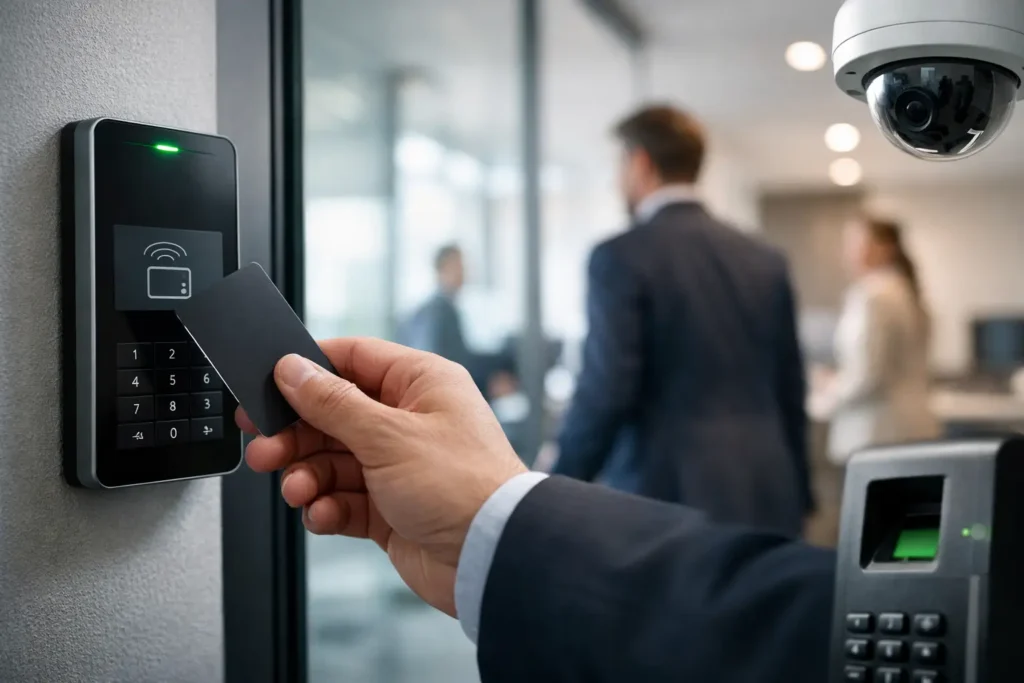
- Credential. Card, fob, mobile credential, PIN, or biometric factor used to request entry.
- Reader. Recognizes the credential and passes data to the decision point.
- Controller. Compares the request to permissions and energizes the lock if valid.
- Management platform. Adds users, assigns doors, sets schedules, and reviews activity. Include door position sensors and request-to-exit inputs for reliable status and safe egress.
Centralized management for multi-site operations
Multi-site businesses gain the most from policy standardization, shared role templates, unified reporting, and consistent onboarding and offboarding. Cloud or hybrid platforms typically simplify:
- Adding a new location with the same roles, schedules, and door naming.
- Disabling a departing employee’s access across all sites at once.
- Viewing door events with associated camera footage, when integrated.
- Proving compliance with documented access logs and change history.
If you are planning new construction or upgrades, coordinate structured cabling and network capacity so controllers, readers, cameras, and intercoms share a tested backbone. For details on cabling quality and planning in Alabama facilities, see Comtex guidance on structured cabling in Birmingham and Montgomery projects at the structured cabling Birmingham resource: https://comtex.org/structured-cabling-birmingham.
Compliance and emergency egress
Access control must align with fire and building codes, life safety, and ADA. Essential practices include free-egress operation, proper door release on fire alarm where required, clear exit signage, and hardware suited to the occupancy type. Documented permissions, change control, and event logs support audits in schools, medical offices, and regulated inventory areas. Work with a provider that coordinates with the Authority Having Jurisdiction (AHJ), fire alarm contractors, and your IT team.
Real Alabama use cases
- Offices in Montgomery. Standard weekday schedules, visitor management at the lobby, role-based access to suites and server rooms, and mobile credentials for managers. Integration with video lets leaders review events at exterior entrances. Multi-site companies rely on centralized roles to keep policies consistent across branch offices. Explore how integrated systems come together for security systems in Montgomery at https://comtex.org/integrated-business-security-systems/.
- Warehouses around Birmingham and Montgomery. Staggered shift schedules, exterior gates, and controlled inventory cages. Durable readers at loading docks, panic hardware on exit doors, and activity logs tied to video. Hybrid designs keep doors operating locally during internet interruptions. For regional camera coverage during loading and after hours, see security camera installation in Birmingham at https://comtex.org/security-cameras-birmingham.
- Churches in Central Alabama. Flexible schedules for worship, events, and community programs. Time-limited mobile credentials for volunteers and vendors. Cameras provide context at shared entrances. Consider policies that unlock for services and relock with audit trails the rest of the week. Learn how houses of worship deploy surveillance at the video surveillance systems page: https://comtex.org/video-surveillance-systems/.
- Schools and training centers. Secure perimeters, vestibules with intercoms, and strict visitor policies. Card plus PIN or mobile plus PIN at administrative areas. Integration with alarms for lockdown scenarios. Detailed logs support investigations and compliance reviews.
Life expectancy and planning for upgrades
Quality access control systems typically serve 8 to 12 years, often longer with proper maintenance and vendor support. Readers and locks can exceed that lifespan. Expect earlier updates for software, browsers, credential technology, and integrations. Build replacement plans into capital budgets and standardize platforms across sites to simplify service.
The 5 Ds of access control and perimeter security
- Deter. Visible controls, policies, and lighting discourage attempts.
- Detect. Readers, door position sensors, and cameras identify events.
- Deny. Controllers enforce permissions and keep doors secured.
- Delay. Hardware and door construction slow forced entry.
- Document. Event logs and video provide records for response and review.
What is the most common model today
For multi-site businesses, cloud-based or hybrid access control is most common due to centralized management, remote administration, and simplified updates. Single-site facilities with strict IT controls may still prefer on-premise.
FAQ
- What are the three types of access control? Cloud-based, on-premise, and hybrid.
- What is the most common access control system? For multi-site operations, cloud or hybrid, because of centralized administration and scalability.
- What are the four major parts of a door access system? Credential, reader, controller, and management platform, with door status and request-to-exit inputs.
- What is the typical life expectancy? Often 8 to 12 years for core systems, with software and integrations updated more frequently.
- What are the 5 Ds? Deter, Detect, Deny, Delay, Document.
Why Comtex
One accountable partner for doors, cameras, alarms, phones, and the network that connects them. Site assessment, code coordination, structured cabling, clean installation, labeling and documentation, training by role, and ongoing service. For access control design and support in Montgomery and across Central Alabama, start with a local team that understands your facilities. Learn more at the Montgomery access control company page: https://comtex.org/access-control-systems/.
Summary and next step
Choosing cloud, on-prem, or hybrid starts with how your sites operate, who needs access, and how you will manage change. Prioritize life safety, door hardware fit, solid cabling, and centralized roles. Integrate cameras and alarms for clear context and documented response. If you are planning new doors or upgrading multiple locations in Alabama, schedule a walkthrough with Comtex to review openings, policies, and the network behind them.