
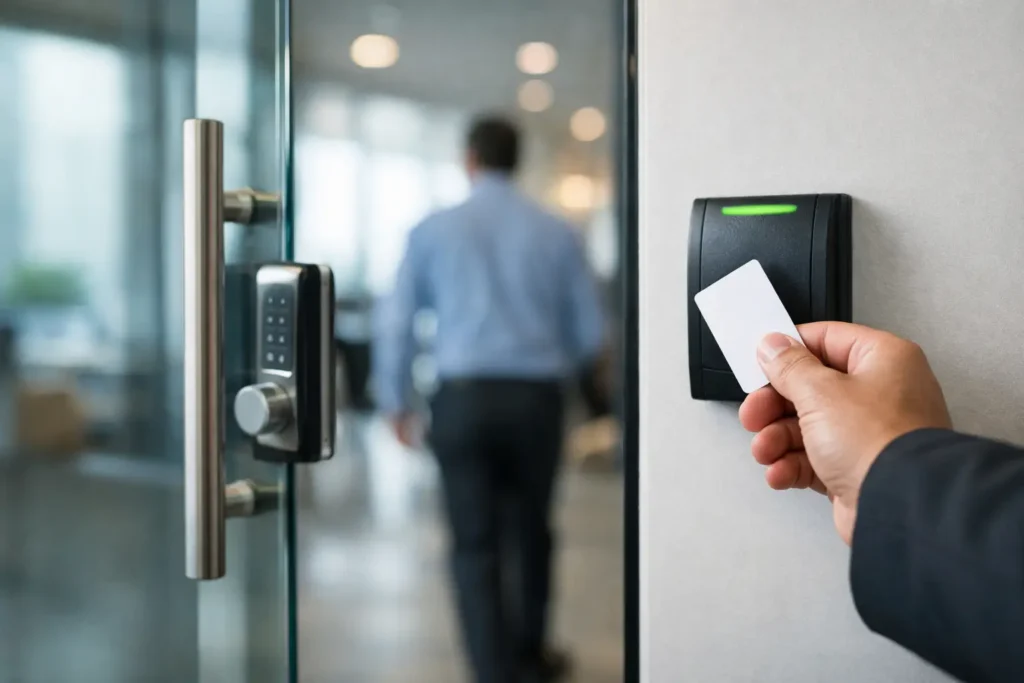
A lost key rarely stays just one lost key. It turns into rekeying doors, tracking who still has access, and wondering whether a former employee can still enter after hours. That is why commercial door access control systems have become a practical business tool, not just a security upgrade. For many organizations, they solve two problems at once – protecting people and property while making day-to-day access easier to manage.
For a business owner or facility manager, the value is straightforward. You can decide who gets in, where they can go, and when they can enter. You are not relying on copies of metal keys that are difficult to track and expensive to replace. You are putting control into a system that can be updated quickly as your staff, vendors, and building needs change.
Comtex began installing access control systems in Alabama in 2014 and has the knowledge of older legacy systems as well as todays highest security Cloud based solutions. Visit www.Comtex.org for more information or call us at 334-271-4000 in Montgomery area and 205-871-3000 for the Birmingham area.
What commercial door access control systems actually do
At the most basic level, commercial door access control systems replace or support traditional keys with managed credentials. Those credentials may be key cards, fobs, mobile credentials, PIN codes, or biometric readers, depending on the application. The system checks whether a person is authorized, then grants or denies entry.
That sounds simple, but the business impact is much bigger. Access can be limited by employee role, by location, or by schedule. A manager may have full building access, while a warehouse employee may only enter certain doors during a shift. A cleaning crew can be granted evening access without opening the entire facility. If someone leaves the company, access can be removed without replacing hardware across the building.
The other major benefit is visibility. Instead of guessing who entered a building or when a door was opened, your team can review activity records. That matters for internal accountability, incident response, and compliance in industries that need stronger documentation of who accessed certain areas.
Why businesses move beyond keys
Most organizations do not decide to change access methods because of a single trend. They do it because physical keys stop fitting the way the business operates. Staff grows. Departments move. Vendors need temporary entry. Multiple locations need a more consistent process. At that point, keys become a management problem.
Electronic access control gives businesses a more flexible model. Changes can be made from an administrative interface rather than through repeated manual key handling. That saves time, but it also reduces the gaps that happen when access decisions are handled informally.
There is also a real difference in how businesses think about risk today. Front doors, office suites, server rooms, inventory spaces, and restricted back-of-house areas all have different security needs. A one-size-fits-all key approach often leaves too much exposure in some places and too much inconvenience in others.
Choosing the right commercial door access control system
Not every system fits every building. The right choice depends on your facility layout, the number of users, how many doors need control, whether you operate one location or several, and how closely access control needs to work with your other systems.
For a small office, a few controlled entry points may be enough. For a healthcare practice, school, industrial property, or multi-tenant commercial site, the design may need to cover interior doors, schedule-based restrictions, visitor access, lockdown capabilities, and reporting requirements. The point is not to buy the most complex system. It is to match the system to the way the business runs.
Credentials are one example of where it depends. Cards and fobs are familiar and cost-effective, which makes them a practical fit for many workplaces. Mobile credentials can reduce the number of physical items employees carry and may simplify administration. PIN-only systems may work well in some controlled areas, but they are less ideal when codes are widely shared. Biometrics can strengthen security in sensitive spaces, but they also introduce cost, policy, and user acceptance questions.
Hardware selection matters just as much. A system has to work with the door, frame, lock type, traffic level, and life-safety requirements of the opening. Retrofitting an older building can be very different from designing for a new construction project. This is where proper site evaluation and standards-based installation make a major difference.
Integration is where the system becomes more valuable
A standalone door system can improve security, but integration is often what turns it into an operational advantage. When access control works alongside video surveillance, alarm systems, intercoms, and network infrastructure, your team gets a clearer picture of what is happening at the facility.
If a door is forced open after hours, a connected system can trigger an alert and tie that event to camera footage. If a delivery driver needs entry at a controlled point, an intercom can support verification before access is granted. If your organization manages multiple business technology systems, having them designed and supported together usually leads to fewer blind spots and less finger-pointing between vendors.
That matters for busy organizations. Many business leaders are not looking for one more platform to manage. They want systems that support operations without creating extra administrative work. A connected approach helps keep security, communications, and infrastructure aligned.
Planning for growth, not just today
One of the most common mistakes in access control is designing only for current headcount or current floor space. Businesses change. Staff numbers increase, departments move, and additional doors often need to be secured later. A system should allow for that growth without forcing a full replacement.
Scalability is not just about adding more readers. It is also about administration. Can you manage users efficiently as the organization changes? Can reports still be useful when you have more sites and more activity? Can the system handle separate permission groups for different departments or tenants? These questions matter early, because they affect long-term cost and usability.
For multi-site businesses in Central Alabama, consistency can be just as important as scale. Standardizing access policies across locations in Montgomery, Birmingham, or surrounding markets can simplify onboarding, reduce confusion, and help leadership maintain better control.
What to expect from implementation
A good access control project starts with understanding how the building is used. That includes entry points, staffing patterns, visitor flow, restricted areas, emergency egress needs, and any existing security or communications systems already in place. The best results come from design that reflects actual operations, not assumptions.
Installation quality has a direct effect on reliability. Poorly installed hardware, weak cable pathways, or shortcuts in door preparation can create recurring service issues that frustrate users and undermine confidence in the system. Businesses are usually better served by working with a provider that understands both the security side and the supporting low-voltage infrastructure behind it.
Training is another part of implementation that should not be overlooked. A system only helps if the people responsible for it know how to add users, adjust schedules, remove access, and respond to common issues. For many organizations, ongoing support matters as much as the original install.
That is one reason businesses often prefer a single accountable partner. When access control connects to alarms, cameras, intercoms, structured cabling, or network services, one experienced provider can simplify planning and service. For companies that want connected and protected solutions without managing multiple contractors, that approach tends to be more efficient. In Central Alabama, Comtex works with businesses that need that kind of integrated support.
Common trade-offs to think through
There is no perfect system for every application. Cloud-managed platforms can offer convenience and easier remote administration, but some organizations prefer more local control depending on policy or IT requirements. Mobile credentials can reduce badge management, but they may not fit every workforce. Highly secure openings may justify stronger authentication methods, while lower-risk areas may be better served by simpler, more economical hardware.
Budget also shapes decisions, but the cheapest option is rarely the least expensive over time. Reliability, support, system flexibility, and installation quality all affect total cost. A lower upfront price can become costly if the system is difficult to expand, inconsistent across doors, or prone to service calls.
The better question is not just what the system costs. It is what level of control, accountability, and operational simplicity your business needs from it.
When it is time to make a change
If your team is still chasing keys, manually tracking who should have access, or struggling to secure different parts of the building in different ways, the current setup may be holding the business back. The same is true if your security systems operate in isolation and no one has a clear view of events across the facility.
Commercial door access control systems are not only for large enterprises or high-security sites. They are often the right fit for growing businesses that need a more dependable way to manage entry, protect assets, and support daily operations. The strongest systems do not just lock doors. They help the business run with more control, less friction, and greater confidence in who can go where and when.
A smart next step is to look at your building the way your business actually uses it, because the right access control plan starts there.