
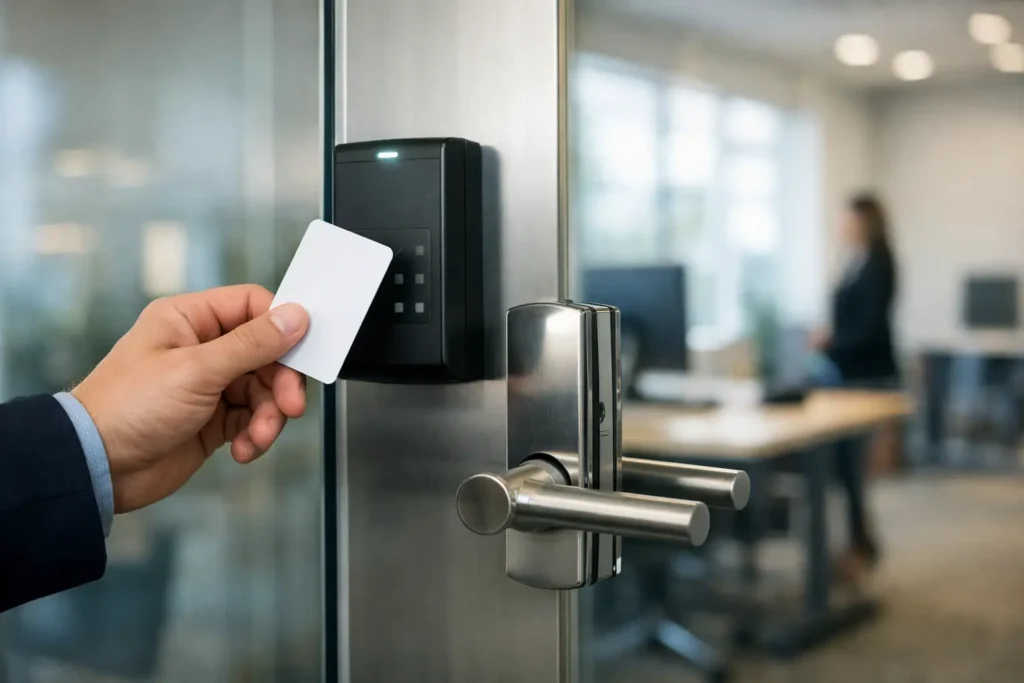
A lost or copied key, an unescorted visitor, or a former employee whose credentials still work can create a real SECURITY gap. Knowing how to plan office access control begins with understanding who needs to enter your facility, which areas need protection, and how access should change throughout the day.
The right system does more than lock doors. It helps protect employees, equipment, records, inventory, and daily operations while giving managers a clear way to grant, change, and remove access. For Central Alabama businesses, the goal is usually practical: secure the facility without creating unnecessary friction for the people who keep it running. Comtex / Furlongs Security can help you just the right system for your building(s). Call us at 334-271-4000 in the Montgomery area or 205-871-3000 in the Birmingham area. Ask for Dale, Paul or Ty on our sales team and any would be happy to assist you. For more information, please visit www.Comtex.org or www.FurlongsSecurity.com.
Start With How Your Office Actually Operates
Before selecting card readers, door hardware, or management software, walk through the building as employees, visitors, vendors, and delivery drivers do. A security plan built only around a floor plan can miss the points where access decisions are made every day.
Consider when the office opens and closes, whether employees work different shifts, and which entrances are used after normal business hours. A professional office may need a controlled main entrance and access to a records room. A warehouse or service company may need separate permissions for offices, stockrooms, loading areas, gates, and equipment storage. A multi-tenant property may need to account for shared entrances and individual tenant suites.
This early review should also identify the doors that are already creating problems. Perhaps staff prop open a rear door because it is inconvenient, managers have too many physical keys in circulation, or a receptionist has no easy way to admit visitors. Those operational details should shape the design.
How to Plan Office Access Control by Risk
Not every door needs the same level of control. Classifying doors by risk helps you direct budget toward the areas that matter most instead of applying the same solution everywhere.
Start with exterior doors. These are often the first priority because they control entry to the building. Then review areas containing sensitive information, cash, medication, tools, servers, inventory, or restricted equipment. Finally, consider internal doors where access separation supports privacy, safety, or accountability.
A useful plan generally separates doors into three groups: public or low-risk areas, employee-only areas, and restricted areas. Public-facing spaces may be open during business hours but secured after closing. Employee-only areas may require a credential at all times. Restricted rooms may limit access to a small group of authorized individuals and maintain a detailed activity record.
Risk is not only about what is behind a door. It is also about the consequences of a door being left open, forced, or accessed at the wrong time. A back entrance with limited visibility may deserve more attention than a highly visible front door, even if both lead into the same office.
Map People, Roles, and Access Schedules
Access permissions should follow job responsibilities, not personal convenience. Make a list of the groups that need access, such as full-time employees, department managers, cleaning crews, contractors, delivery personnel, and tenants. Then determine where each group should be allowed to go and during what hours.
For example, a general employee may have access to the main entrance, shared work areas, and break room from 6 a.m. to 8 p.m. A finance manager may also have access to a records room. A cleaning company may have after-hours access only to designated areas. This role-based approach is easier to manage than assigning permissions one person at a time without a consistent standard.
Plan for exceptions without making them permanent. Temporary credentials for a contractor, seasonal worker, or short-term tenant should have an expiration date. When an employee changes roles or leaves the organization, access should be updated promptly as part of the same offboarding process used for keys, computers, and accounts.
Choose Credentials That Fit Your Workforce
Key cards and fobs remain a dependable choice for many businesses because they are familiar, affordable, and easy to issue. Mobile credentials can be a good fit for organizations that want employees to use a smartphone rather than carry another item. PIN codes may work in certain settings, but they can be shared or forgotten, so they are often best used with another credential type for more sensitive areas.
The right choice depends on your team and your environment. A busy facility with gloves, uniforms, or frequent movement between doors may benefit from simple, durable fobs. An office with a mobile-focused workforce may prefer phone-based credentials. In either case, make sure lost credentials can be deactivated quickly and replacements can be issued without interrupting work.
Biometric access may be appropriate for higher-security environments, but it brings additional cost, privacy considerations, and administration requirements. It should be selected because the risk justifies it, not because it appears more advanced.
Plan the Door Hardware, Not Just the Reader
An access control system is only as dependable as the opening it controls. The reader, lock, door frame, hinges, power supply, request-to-exit device, and fire alarm interface all need to work together correctly.
This is where a site assessment is essential. A glass storefront door, a hollow metal exterior door, a wood office door, and an overhead gate each require different hardware and installation methods. Door condition matters as well. If a door does not latch properly or the frame is damaged, electronic access control will not correct the underlying problem.
Life safety must guide every decision. Doors must allow safe egress during an emergency and comply with applicable fire and building requirements. Certain openings may need to unlock upon a fire alarm signal, while others may require different configurations based on their use. Qualified system design and standards-based installation help avoid costly corrections later.
Decide What the System Should Tell You
Access control can provide useful information, but only if it is planned around real management needs. At a minimum, most businesses benefit from knowing who accessed a controlled door, when it happened, and whether a door was held open or forced.
Managers may also want automatic reports for after-hours activity, alerts when a restricted door is opened, or a way to remotely manage a door during special events. For a multi-site business, centralized management can reduce the burden of handling credentials and schedules at each location.
Avoid collecting data simply because the platform can produce it. Too many alerts can lead to ignored notifications. Set priorities for events that require a response, identify who receives them, and establish what that person should do next. A forced-door alert is only valuable if someone can investigate it.
Connect Access Control With the Rest of the Facility
Access control is most effective when it works as part of a connected security and communications plan. Video surveillance can help verify door events and investigate incidents. An intercom or video entry system can give staff a controlled way to communicate with visitors before granting entry. Alarm systems can add another layer of protection for after-hours intrusion detection.
Integration should solve a specific operational problem. A camera view tied to a door event can reduce investigation time. A receptionist who can speak with a visitor before remotely releasing the front door can improve both security and customer service. On the other hand, adding every possible feature can increase cost and administrative complexity without providing a meaningful return.
Businesses that are renovating, relocating, or expanding should also coordinate access control with structured cabling, network capacity, Wi-Fi coverage, and power planning. Addressing these requirements early keeps the project organized and reduces the need for disruptive changes after walls are closed or finishes are complete.
Build Administration Into the Plan
Even a well-designed system can lose value if no one owns the day-to-day process. Assign clear responsibility for issuing credentials, approving access changes, reviewing activity when needed, and responding to system alerts. Smaller organizations may assign this role to an office manager or operations leader, while larger businesses may divide responsibilities among facilities, HR, security, and IT.
Document the basic rules before installation is complete. Define how employees request access, how temporary access is issued, how quickly access is removed after separation, and who can approve exceptions. Review these rules periodically, especially after a move, leadership change, or incident.
Ongoing support matters as much as the initial installation. Comtex helps Central Alabama businesses plan, install, and maintain connected security infrastructure with one accountable provider, so access control can remain aligned with the facility and the way the business operates.
A good access control plan should make the right action easy: employees enter where they should, visitors are handled professionally, and managers can act quickly when access needs change. Start with the doors and risks you have today, then choose a system that can grow with the business you are building.