
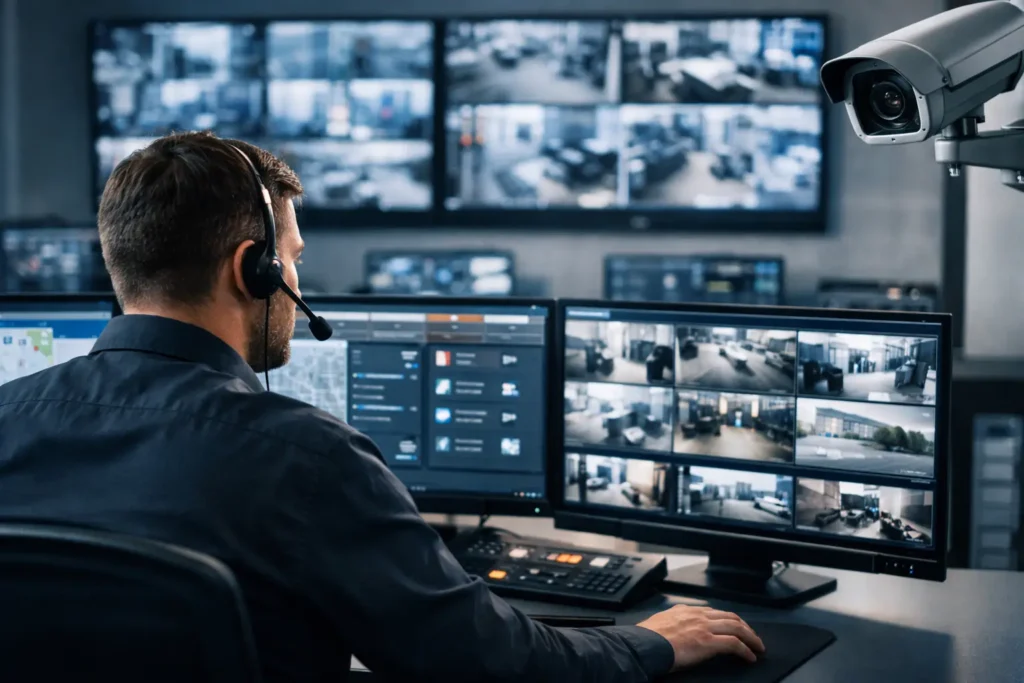
A break-in alarm at an empty office is only as useful as the response it triggers. That is the practical answer to the question, what is a central alarm monitoring system? It is a service that receives alarm signals from your business around the clock, evaluates the event, and follows an established response plan when action is needed.
For commercial facilities, central monitoring adds a human response layer to security equipment. Instead of relying on an employee to see a notification after hours, a trained monitoring operator receives the signal and takes the next appropriate step. Depending on the alarm type and your instructions, that may mean calling designated contacts, notifying law enforcement or fire services, or coordinating a response to a potentially urgent condition.
What Is a Central Alarm Monitoring System Designed to Do?
A central alarm monitoring system connects alarm devices at your facility to an off-site monitoring center. Those devices may include door contacts, motion detectors, glass-break sensors, panic buttons, fire alarm panels, temperature sensors, water detection devices, and other supervised equipment.
When a device detects an event, the alarm panel communicates it through a secure path such as cellular, internet-based, or phone communication. The monitoring center receives the signal, identifies the account and event type, and works through the response instructions established for that location.
The system is designed to reduce the gap between an alarm occurring and someone taking informed action. It does not prevent every intrusion, fire, or equipment failure. What it does provide is dependable oversight when a facility is closed, understaffed, or too large for one person to monitor effectively.
For a business with several locations, monitoring can also create a more consistent response process. Rather than each site handling emergencies differently, leadership can establish clear contacts, escalation procedures, and account-level instructions across the organization.
How Central Alarm Monitoring Works
The process starts at the protected location. Sensors and alarm devices report to a control panel, which continually checks the status of connected equipment. When the system is armed and a protected point is breached, or when a life-safety device reports an event, the panel sends a code to the monitoring center.
That code tells the operator what happened and where. A signal may identify a rear-door intrusion, a lobby panic alarm, a fire alarm activation, a low-temperature condition in a critical storage area, or a communication trouble signal from the panel itself.
The monitoring operator then follows the response plan for that account. A typical process may include calling the premises, contacting authorized personnel, and requesting emergency dispatch when the event and account instructions call for it. The exact sequence depends on the type of alarm, local requirements, and the procedures your organization has approved.
Alarm verification and response procedures
Not every signal should receive the same response. A burglary alarm may require verification steps intended to reduce false dispatches. A panic alarm, fire alarm, or medical emergency signal can require a more immediate protocol. The right process depends on the system, the facility, and applicable local rules.
This is why accurate contact information matters. Monitoring is most effective when the operator has current phone numbers, decision-makers who understand their responsibilities, and clear instructions for after-hours access, alarm cancellation, and escalation.
Communication paths matter
An alarm system needs a reliable way to send signals off-site. Traditional phone lines can still be present in some environments, but many commercial systems now use cellular or network communication. Some facilities use dual-path communication, which provides a secondary route if the primary path is disrupted.
The best approach depends on your building, network design, risk level, and operational needs. A facility with critical inventory, sensitive records, or extended vacant hours may need more redundancy than a small office occupied only during standard business hours.
What Central Monitoring Can Cover
Central monitoring is often associated with burglary alarms, but commercial monitoring can support a wider range of conditions. The value comes from matching monitored signals to risks that could interrupt business operations or endanger people and property.
Common monitored conditions include:
- Intrusion events from doors, windows, motion detectors, and glass-break devices
- Fire, smoke, heat, sprinkler, and supervisory signals where applicable
- Panic or duress alarms for staff working with cash, patients, visitors, or the public
- Environmental conditions such as high temperature, low temperature, water leaks, and power loss
- System troubles, including low batteries, communication failures, and panel tampering
A monitored signal should have a purpose. Adding devices simply because they are available can create unnecessary complexity and false alarms. A professional system design starts with how the building is used, what needs protection, when the facility is occupied, and which events require immediate attention.
Central Monitoring vs. Self-Monitored Alerts
Self-monitoring usually sends a text, app notification, email, or automated call directly to designated employees. It can be a reasonable option for lower-risk locations where someone is reliably available to respond. It also gives businesses direct visibility into system activity.
However, self-monitoring places the responsibility on your team. If a manager is in a meeting, driving, asleep, on vacation, or dealing with a different emergency, an alert can go unanswered. Personnel turnover can also leave outdated contacts and missed notifications in place.
Central monitoring provides dedicated coverage outside your organization. The monitoring center is responsible for receiving the event and following the account instructions, while your internal team remains informed through the contacts and notifications you select.
Many businesses use both approaches. They want designated managers to receive notifications, while also maintaining professional monitoring for critical alarms and after-hours events. This combination can support stronger awareness without making employees the only line of response.
Why Integration Improves the Result
An alarm system performs better when it is planned alongside the rest of a facility’s technology. Video surveillance can help provide visual context around an alarm event. Access control records can show whether a credential was used at a door near the time of an alarm. Intercom systems can support communication at controlled entrances. Network design affects how connected security devices communicate and remain available.
Integration does not mean every system must be tied together in a complicated way. It means the systems should be designed to support the same operational goals. For example, a warehouse may need intrusion detection at loading doors, cameras covering entry points, access control for staff doors, and monitoring for after-hours alarms. A medical office may prioritize panic alarms, controlled access, video coverage, and dependable communications.
Working with one accountable provider can simplify this planning. It also helps prevent the common problem of separate systems being installed without clear ownership of the wiring, network connection, programming, or ongoing service needs.
Choosing a Monitoring Setup for Your Business
The right central monitoring solution begins with a site-specific assessment, not a generic equipment package. Consider the facility’s hours, number of entrances, employee activity, public access, valuable assets, existing systems, and the consequences of an undetected event.
Ask how signals will be transmitted, what happens if internet service fails, who is authorized to cancel an alarm, and who must be contacted after hours. Review local false-alarm ordinances as well. Repeated false alarms can create unnecessary disruption and potential fees, so user training, proper device placement, and routine service are part of an effective monitoring strategy.
It is also wise to review your response list at least annually and whenever staffing changes. A monitoring center can only act on the instructions and contacts on file. Outdated call lists are one of the most avoidable weaknesses in an otherwise well-designed system.
For Central Alabama businesses, Comtex can help evaluate alarm monitoring as part of a connected plan for security, communications, access control, surveillance, and network infrastructure. The goal is not simply to add another vendor service. It is to create a response process that fits how your facility operates and gives your team a clear path forward when an alarm occurs.