
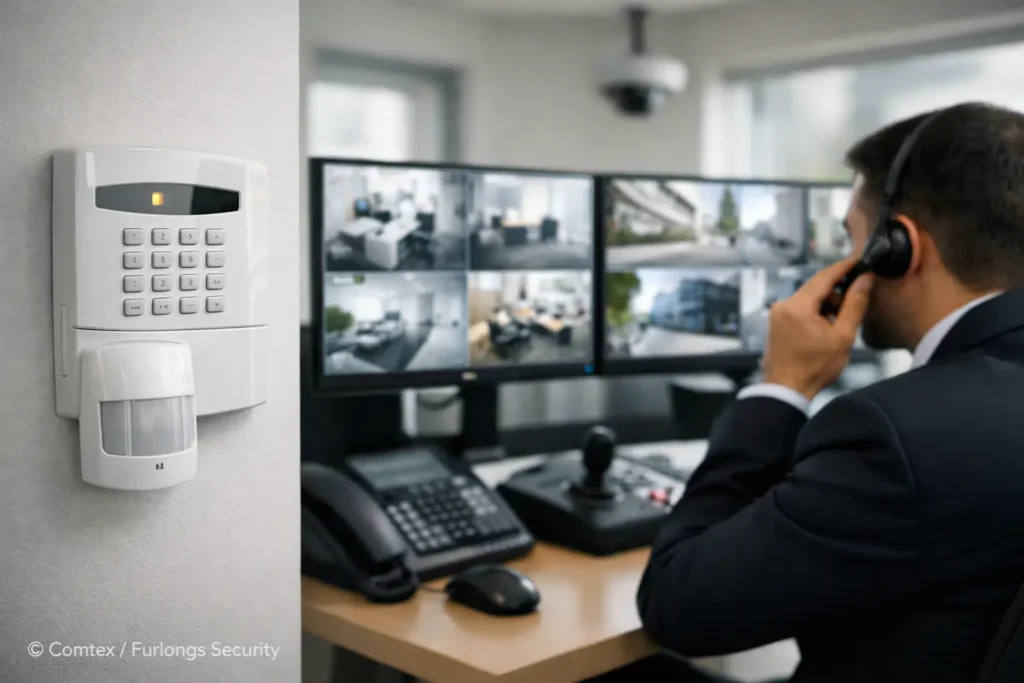
A burglar alarm can detect an open door or broken glass. What happens next determines whether it protects your business. The best commercial alarm monitoring options connect your system to trained professionals who can verify signals, follow your response plan, and request emergency dispatch when needed – day or night, including when your building is unoccupied.
For Central Alabama businesses, monitoring should not be treated as a generic monthly service. The right choice depends on the facility, the assets being protected, employee schedules, local response procedures, and how the alarm system connects with access control, cameras, and network infrastructure. A dependable monitoring plan is designed around the way your organization actually operates.
What Commercial Alarm Monitoring Should Do
Commercial monitoring begins when an alarm panel sends a signal to a central monitoring station. Operators receive the event, follow the account’s documented instructions, contact the appropriate people, and notify police, fire, or other emergency services when the situation calls for it. This process provides a response path when an owner, manager, or security team cannot immediately answer a call. Call Comtex / Furlongs for more information about our Central Station at 334-271-4000.
A business-grade solution should also supervise the connection between the alarm panel and the monitoring station. If a communication path is interrupted, the system should report the trouble condition rather than leaving the business unaware that its protection has been compromised. That distinction matters. An alarm is only as dependable as its ability to communicate when an event occurs.
The best monitoring arrangement is not necessarily the one with the longest feature list. It is the one that provides clear notification procedures, reliable communication, appropriate verification, and accountable service for the risks your facility faces.
Best Commercial Alarm Monitoring Options to Consider
24/7 professional central station monitoring
For most businesses, professionally monitored service is the foundation. A trained central station receives burglary, panic, hold-up, supervisory, and other designated signals around the clock. Operators work from a defined call list and escalation plan, helping ensure a security event does not wait until someone checks an app or arrives at the office the next morning.
This option is particularly valuable for businesses with limited after-hours staffing, such as medical offices, retail locations, warehouses, churches, professional offices, and property management operations. It also provides continuity when managers are traveling, changing roles, or handling multiple locations.
The trade-off is that professional monitoring requires accurate account information. Contact lists, passwords, authorized users, and opening or closing schedules need to be maintained. A strong provider helps make that process manageable and reviews procedures when operations change.
Cellular alarm monitoring
Cellular communicators use wireless networks to send alarm signals. For many commercial properties, this is the preferred primary path or an essential backup because it does not rely solely on a traditional phone line or the building’s internet connection.
Cellular service can be a practical choice for standalone buildings, construction sites, remote equipment areas, and locations where internet service may be interrupted. It can also reduce exposure to a simple cut or failure affecting one communication method. Signal availability and the building’s construction still need to be assessed during system design, especially in basements, metal structures, and large facilities.
Dual-path monitoring with cellular and internet
Dual-path monitoring uses two separate communication methods, commonly internet and cellular. If one path is unavailable, the other can continue reporting signals. This approach is often the strongest fit for businesses that cannot afford a single point of failure.
A medical facility, financial office, multi-tenant property, high-value inventory location, or business with several access points may benefit from this added resilience. The investment is higher than a single-path connection, but the value is straightforward: an alarm panel has another route to reach the monitoring station when the primary route is down.
Internet monitoring can report quickly and efficiently, but it should be designed with the business network in mind. Network changes, firewall settings, power outages, and equipment replacements can affect communication. When the company that supports your security and connectivity infrastructure understands both sides, troubleshooting is faster and responsibility is clearer.
Video-verified alarm monitoring
Video verification combines alarm activity with visual information from integrated cameras. Depending on the system design and service level, monitoring personnel may review video associated with an alarm event to help determine whether there is an apparent threat.
This option can be useful for locations that experience false alarms, have large outdoor areas, or need stronger situational awareness before escalating a response. It may help distinguish a person entering a restricted area from environmental movement or an accidental activation. It can also provide better information for the business team responding to an event.
Video verification is not a replacement for properly placed intrusion detection. Cameras need appropriate lighting, coverage, bandwidth, retention settings, and privacy considerations. The best results come from designing cameras and alarm devices as one coordinated security system rather than adding video after the fact.
Managed opening, closing, and exception reporting
Some commercial monitoring programs can report when a system is armed or disarmed outside expected schedules. If a business normally closes at 6 p.m. but remains disarmed late into the evening, designated contacts can receive an exception notification.
This is a helpful operational layer for retail stores, schools, offices, service businesses, and multi-site organizations. It supports accountability without requiring a manager to manually confirm every location each day. It is most effective when schedules are realistic and exceptions are reviewed, not ignored.
Remote system management and mobile alerts
Remote access gives authorized users visibility into system status and selected event notifications. Managers may be able to confirm whether a location is armed, receive alerts, or review activity while away from the facility. These tools are useful, but they should complement professional monitoring rather than replace it.
A mobile alert reaches a person who may be driving, in a meeting, asleep, or unable to respond. Professional monitoring provides the defined response process behind the notification. Remote access also requires careful user management, strong passwords, and timely removal of access when employees leave.
How to Choose the Right Monitoring Setup
Start with the risks that are specific to your building. A storefront with cash drawers has different concerns than a warehouse with loading docks, a medical office with controlled substances, or an apartment community with shared access points. Consider what must be protected, when the property is vacant, and which events require an immediate response.
Next, evaluate communication reliability. Ask whether the system will use cellular, internet, or both, and what happens during a power outage or network interruption. Alarm panels, communication devices, network equipment, and cameras should have appropriate backup power based on the level of protection required.
Your response plan deserves the same attention as the equipment. Identify primary and secondary contacts, confirm who can make decisions after hours, and document when police, fire, or private security should be contacted. For multi-site businesses, consistent procedures across locations make training and management far easier.
Finally, look beyond the monitoring station. Installation quality, device placement, system testing, local service availability, and ongoing maintenance all affect performance. A poorly installed system with premium monitoring can still create false alarms, missed zones, and avoidable service calls.
Integration Makes Monitoring More Useful
Alarm monitoring is more effective when it works alongside the rest of the building’s security and communications systems. Access control can show which credential opened a door. Video surveillance can provide visual context. Intercom systems can support visitor verification. Reliable structured cabling, network design, and wireless coverage help keep connected devices communicating as intended.
This integration does not mean every business needs every technology. A small office may need professional monitoring, cellular backup, and a few properly selected detection devices. A larger campus may need alarm, access control, cameras, intercom, and multiple communication paths coordinated under one management plan. The right scope follows the business need, not a one-size-fits-all package.
For organizations that prefer one accountable partner for connected and protected solutions, Comtex can design, install, monitor, and support commercial security systems with the larger operational environment in mind.
A monitoring service should give your team confidence that an alarm event has a defined path forward, even when no one is standing at the panel. Review that path regularly, keep contacts current, and choose a system built to communicate when your business needs it most.