
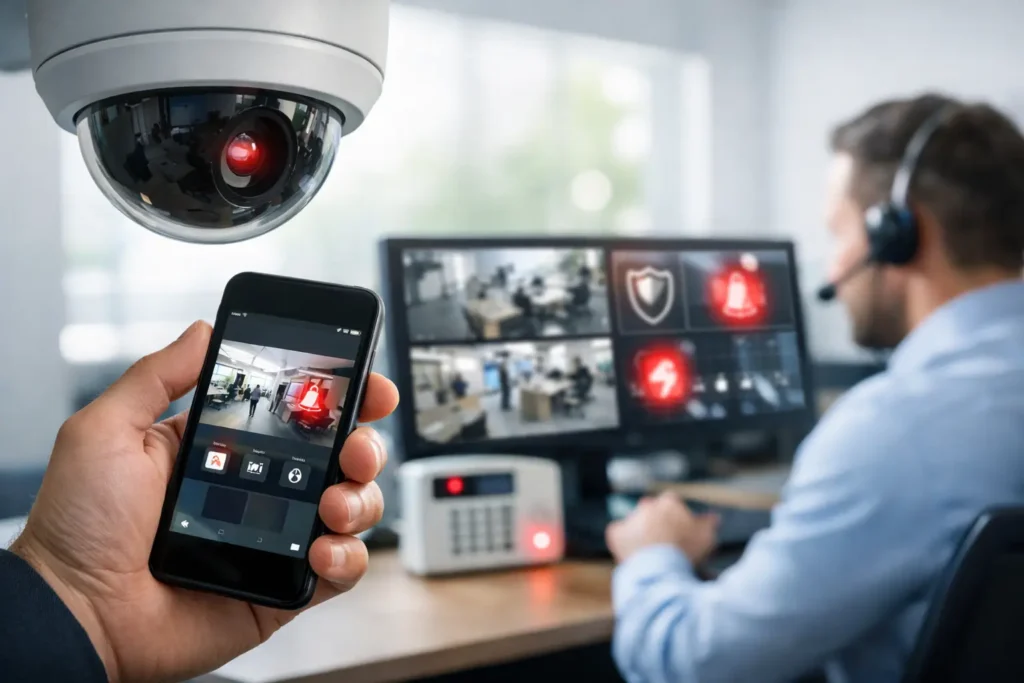
A break-in alarm that only sounds on-site can be effective when someone is present to hear it. At 2:00 a.m., during a holiday closure, or at an unattended satellite location, that same alarm may provide little more than noise. So, is alarm monitoring worth it for a business? For many Central Alabama organizations, the answer is yes – provided the system is designed correctly, monitored by a reliable center, and supported by a clear response plan.
Professional monitoring gives your alarm system an active path to action when an event occurs. Instead of relying on an employee, neighbor, or property manager to notice an alarm, trained operators receive the signal, follow established procedures, and contact the appropriate people or emergency responders when needed. That added layer can make a meaningful difference in how quickly an incident is addressed and how confidently a business can operate after hours.
What Alarm Monitoring Actually Does
Alarm monitoring connects intrusion, fire, panic, supervisory, and other alarm signals to a monitoring center that operates around the clock. When a protected device is triggered, the center receives the signal and follows the account instructions established for that location.
For an intrusion event, that may involve calling designated contacts and requesting law enforcement dispatch based on the agreed procedure. A fire or life-safety signal may follow a different escalation process. The exact response depends on the system type, local requirements, alarm verification procedures, and the instructions your organization has authorized.
Monitoring does not physically stop a break-in, put out a fire, or guarantee an emergency response time. Its value is in ensuring that an alarm signal is not ignored simply because the building is empty or the right employee is unreachable. It creates a dependable handoff from your security equipment to a documented response process.
Is Alarm Monitoring Worth It? Consider the Cost of a Missed Event
The monthly cost of monitoring is straightforward. The cost of a missed event is often less predictable. A burglary can result in stolen equipment, inventory loss, damaged doors or windows, cleanup, business interruption, and insurance complications. A water, temperature, or power-related alert in the right environment can also become costly if nobody learns about it until the next business day.
For a retail store, the question may center on merchandise and cash-handling areas. For an office, it may be computers, records, and employee safety. For warehouses, medical facilities, schools, houses of worship, and multi-tenant properties, the concern can extend to large buildings, multiple entry points, or locations that are not consistently staffed.
Monitoring is most valuable when the consequences of delayed awareness exceed the ongoing service cost. That calculation is different for every organization, but it should include more than the value of what could be stolen. Consider downtime, emergency repairs, disruption to employees and customers, and the management time required after an incident.
When Monitoring Makes the Most Business Sense
Businesses with regular after-hours vacancies are strong candidates for alarm monitoring. This includes offices that close overnight, stores with limited staffing, construction sites, storage facilities, and properties with remote equipment rooms. The longer a facility can sit unattended, the more important timely notification becomes.
Multi-site organizations also benefit because a central monitoring process reduces the burden on local managers. Rather than expecting each location to maintain its own call tree and response habits, leadership can establish consistent instructions across facilities while still assigning location-specific contacts.
Monitoring can be especially useful for owners and facility managers who do not want to be the only person responsible for every overnight alert. A well-built contact list gives the monitoring center multiple ways to reach the right people, while escalation instructions prevent a single missed phone call from becoming a dead end.
Situations Where It May Not Be the Right Fit
Monitoring is not automatically necessary for every system. A low-risk, continuously staffed area may have less need for after-hours intrusion monitoring. Some businesses may choose local audible alarms, access control alerts, or video notifications for specific doors rather than full monitored protection throughout the building.
The issue is not whether monitoring is good or bad. It is whether it addresses a real operational risk. Paying for a service that generates frequent false alarms, reaches outdated contacts, or covers poorly selected areas will not deliver much value. A smaller, properly designed monitored system is often a better investment than a larger system with no clear response plan.
Organizations should also account for local false alarm ordinances and potential fees. Repeated false dispatches can create unnecessary costs and reduce confidence in the system. Proper installation, reliable equipment, user training, and regular maintenance are essential parts of making monitoring worthwhile.
The Quality of the System Determines the Value
Monitoring is only as useful as the signal it receives. Door contacts, motion detectors, glass-break sensors, panic devices, control panels, communications paths, and backup power all need to work together. If an alarm panel cannot communicate because of a network failure, power issue, or outdated cellular communicator, the monitoring service cannot respond to an event it never receives.
That is why commercial alarm planning should begin with the facility and the business process, not a generic equipment package. A professional assessment can identify vulnerable entry points, restricted areas, high-value assets, employee traffic patterns, and practical arming schedules. It can also determine whether the alarm system should tie into access control, video surveillance, intercoms, or network infrastructure.
For example, an access control event after hours may prompt a camera review, while a forced-door alarm can identify the affected entry point immediately. Integration does not replace a response plan, but it gives decision-makers better information when an alarm occurs. It also reduces the number of separate systems employees must learn and manage.
Build a Response Plan Before an Alarm Happens
A monitored alarm account needs current, usable instructions. Before activating service, identify who should receive calls, who has authority to cancel or confirm an alarm, and who can access the property if needed. Include more than one contact and review those names whenever staffing changes.
Your plan should also define how employees arm and disarm the system, what to do if they accidentally trigger an alarm, and when service should be called. Employees do not need technical training to follow these procedures, but they do need consistent guidance. Clear practices reduce false alarms and help protect the credibility of your security program.
If your organization has multiple locations, establish the same baseline process at each site while allowing for local differences. A warehouse may need a different contact order than an administrative office. A site with on-call maintenance staff may handle utility alerts differently than a retail location. The goal is a response plan that works at 2:00 a.m., not just one that looks complete in a file.
Choosing a Monitoring Partner
The lowest monthly price is rarely the best measure of value. Ask how alarm signals are handled, what communication methods are supported, how service issues are addressed, and whether the provider can support your system after installation. You should also understand contract terms, testing procedures, available maintenance, and who is accountable when equipment needs attention.
For businesses managing networks, phones, access control, surveillance, and alarms, there is a practical advantage in working with a provider that understands how these systems affect one another. Comtex helps Central Alabama businesses plan, install, service, and support connected security and communications systems through one accountable partner.
A properly monitored alarm system should feel less like another vendor expense and more like a dependable part of facility operations. When the building is closed and an unexpected event occurs, the real value is knowing the signal has somewhere to go – and that someone is prepared to act on it.