
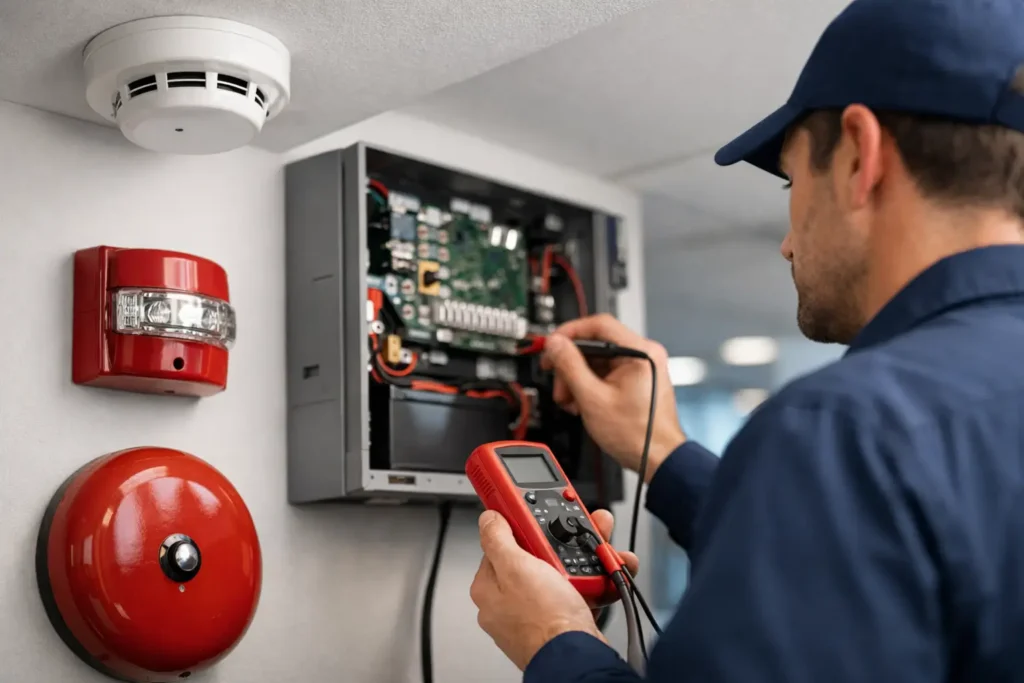
A fire alarm panel can look perfectly normal while a disconnected device, depleted backup battery, or blocked pull station creates a serious gap in protection. To maintain commercial fire alarms effectively, businesses need more than an occasional inspection after a problem appears. They need a disciplined plan that keeps detection, notification, communication, and documentation working together.
For Central Alabama businesses, that plan protects people first. It also helps reduce operational disruption, supports code compliance, and gives facility leaders confidence that their building is prepared when a real emergency occurs.
Why commercial fire alarm maintenance cannot wait
A commercial fire alarm system is a life-safety system, not a set-it-and-forget-it installation. Smoke detectors can collect dust. Heat detectors can be affected by changing room conditions. Batteries age. Construction work can damage wiring or leave devices covered, moved, or obstructed. Even a minor tenant improvement can change the way a system should operate.
The consequences extend beyond a failed inspection. If alarms do not activate or occupants cannot hear or see notification appliances, a fire event can become more dangerous in seconds. A recurring trouble signal can also condition staff to ignore the panel, which is precisely the wrong response when the system is reporting a real problem.
Maintenance is also a business continuity issue. A system impairment may require fire watch procedures, temporary changes to building operations, coordination with the authority having jurisdiction, and rapid service calls. Scheduled care is usually far less disruptive and more predictable than reacting to an urgent failure.
Build a plan to maintain commercial fire alarms
The right maintenance schedule depends on the building, its occupancy, the system design, equipment manufacturer requirements, local codes, and the authority having jurisdiction. National Fire Protection Association standards, including NFPA 72, commonly guide testing and inspection practices, but the applicable local requirements should always control.
A dependable program separates routine awareness tasks from qualified inspection, testing, and service. Facility personnel play an important role, but they should not be expected to diagnose panel faults, alter programming, or perform work reserved for trained fire alarm technicians.
Start with an accurate system inventory
Your maintenance provider should know what is installed and where. That includes the fire alarm control panel, remote annunciators, smoke and heat detection, manual pull stations, horn strobes, speaker systems, duct detectors, sprinkler monitoring devices, elevator recall interfaces, door release connections, and monitoring communication equipment.
This inventory matters because fire alarm systems are often expanded over time. A building may have original devices in one area, newer devices in an addition, and equipment from multiple manufacturers. Without current drawings, device records, and panel information, service becomes slower and errors become more likely.
Keep updated records of device locations, prior test results, repair history, battery replacement dates, inspection reports, and any changes made to the building. If your facility has multiple sites, use a consistent recordkeeping approach across all locations. It makes trends easier to identify and gives operations teams a clearer picture of system condition.
Use the right testing intervals
Some visual checks can happen frequently, while other tests occur on a monthly, quarterly, semiannual, or annual basis. Certain devices may require more extensive testing on longer cycles. The exact schedule should be established according to applicable requirements and the equipment installed in your facility.
Regular visual checks can identify obvious issues before they become bigger problems. Staff should report a panel displaying trouble or supervisory conditions, a blocked pull station, damaged detector, missing lens on a notification appliance, or an area where construction materials are covering devices.
Qualified technicians should conduct the functional testing. This can include verifying initiating devices, confirming horns, strobes, speakers, and annunciators operate as intended, checking batteries and power supplies, and ensuring signals reach the monitoring center when monitoring is part of the system. Testing should also confirm that connected building functions respond properly. Depending on the design, that may include releasing access-controlled doors, recalling elevators, controlling smoke dampers, or shutting down air-handling equipment.
A test that only makes the panel sound is not enough. The system must perform as a connected life-safety system.
Treat trouble signals as service needs
A trouble signal is not the same as an alarm, but it still requires prompt attention. It may indicate loss of AC power, a weak battery, communication failure, ground fault, open circuit, device issue, or another condition that could affect system performance.
Do not silence a recurring trouble condition and assume it can wait until the next inspection. The panel may continue to operate in some capacity, but the source of the trouble needs to be identified. A communication fault, for example, can affect the ability to send emergency signals to a monitoring provider. A battery fault can leave the system vulnerable during a power outage.
Make sure staff know who is authorized to acknowledge signals, who contacts the service provider, and when management needs to be notified. Clear escalation procedures prevent a panel issue from being passed from shift to shift without resolution.
Protect devices during daily operations and building changes
Many fire alarm problems begin with ordinary business activity. Warehousing can block strobes and pull stations. Painting, sanding, and drywall work can contaminate smoke detectors. New shelving, partitions, or ceiling changes can affect coverage. A remodeling project can interrupt circuits or create dust that causes unwanted alarms.
Before renovation, expansion, or equipment installation begins, include the fire alarm provider in the planning conversation. The system may need temporary protection, device relocation, added detection, programming changes, or testing after the work is complete. This is especially important in healthcare facilities, schools, manufacturing environments, multifamily properties, and buildings with complex access control or emergency communication requirements.
The same attention applies to changes in occupancy. A space that changes from offices to storage, or from storage to a customer-facing area, may have different protection and notification needs. The goal is not simply to preserve the original installation. It is to keep the system appropriate for the building as it operates now.
Coordinate fire alarms with security and network systems
Commercial fire alarms often interact with other critical systems. Access control doors may need to unlock during an alarm. Video surveillance can help security teams assess an event. Internet or cellular communication paths may support alarm monitoring. Building networks may be involved in supervision or reporting, depending on the design.
Integration creates operational benefits, but it also requires coordination. Changes to door hardware, network equipment, phone service, or building power should be reviewed for possible fire alarm impact. A new security project should not compromise egress. A network change should not interrupt a required communication path. Different contractors working independently can miss these dependencies.
A single accountable technology partner can simplify this process by coordinating systems instead of treating each one as an isolated project. For businesses managing security, communications, and connectivity across one or several facilities, this approach can reduce confusion when service is needed.
Choose a service partner prepared for your facility
The lowest-cost inspection is not always the best value. A provider should understand the equipment in your building, follow applicable testing requirements, document results clearly, and explain deficiencies in terms your team can act on. They should also be prepared to support repairs, replacement planning, monitoring coordination, and system modifications when your operation changes.
Ask practical questions. Who performs the inspection? What is included in the test? How are deficiencies documented? How quickly can the provider respond to a trouble condition? Can they service the related access control, network, and communications infrastructure that may affect system operation?
For older systems, replacement may be the responsible choice when parts are unavailable, devices are unreliable, or repeated repairs are becoming costly. That decision depends on the system condition, building use, budget, and risk tolerance. A qualified provider can help distinguish between a repairable issue and a system that needs a phased modernization plan.
Comtex helps Central Alabama organizations manage connected protection systems with installation, service, and ongoing support designed around their facilities. The most useful maintenance plan is one your team can follow consistently, with clear records, prompt response to deficiencies, and qualified help when the building changes. That preparation gives your people a safer place to work and gives operations leaders one less critical uncertainty to carry.