
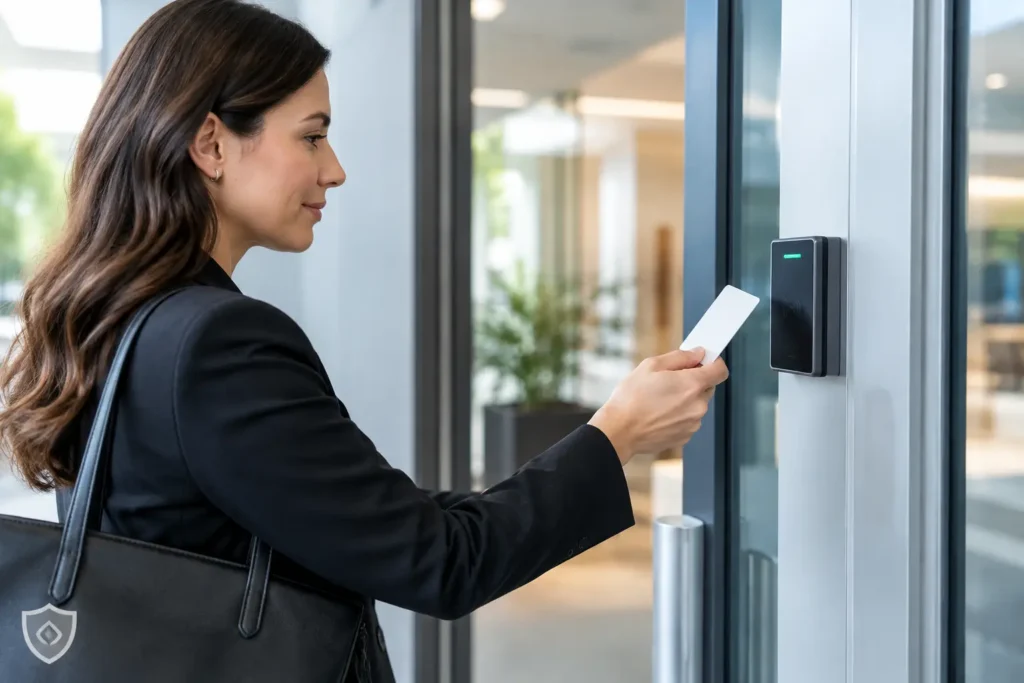
A lost key can create a problem long after it is noticed. A former employee may still have access to a side entrance. A delivery door may be left unsecured during a busy shift. A manager may have no clear record of who entered a restricted area after hours. Access control gives businesses a practical way to manage these everyday risks without making the workday harder for employees and visitors.
For Central Alabama organizations, the right system does more than replace metal keys. It establishes clear rules around who can enter, where they can go, and when access should be allowed. That means better protection for people, inventory, equipment, records, and daily operations.
What Access Control Does for a Business
Access control is a physical security system that uses credentials such as key cards, fobs, mobile credentials, PINs, or biometric readers to control entry through designated doors, gates, or secured spaces. Instead of rekeying locks when staff changes occur, an authorized administrator can add, remove, or adjust permissions through the system.
The value is not simply the technology at the door. It is the ability to apply a consistent security policy across a facility. An employee may need access to the main entrance and their department during normal business hours, while a supervisor may need after-hours access to additional areas. A vendor may receive limited entry for a short period without being given a permanent key.
This level of control is useful in offices, medical practices, schools, warehouses, churches, apartment properties, manufacturing facilities, and multi-tenant commercial buildings. The exact configuration depends on the facility, its hours, employee roles, and the assets that need protection.
Why Traditional Keys Create Ongoing Exposure
Mechanical locks remain appropriate for some doors, storage areas, and low-risk spaces. They are familiar, cost-effective, and do not require power or network connectivity. But keys have limitations when a business needs accountability and flexibility.
A key can be copied without permission, misplaced without being reported, or retained after an employee leaves. Once a key is outside the business’s control, there is no reliable way to know who has it. Rekeying may solve the immediate concern, but it can become costly and disruptive when changes happen often or when several doors are involved.
Electronic access control changes that equation. Credentials can be deactivated quickly, schedules can be changed without replacing hardware, and entry events can be reviewed when questions arise. For a facility manager, that can reduce administrative work. For an owner or operations leader, it provides clearer oversight of the building.
Building Access Control Around Real Operations
A system should support how a business operates, not force the business into an inconvenient routine. Before selecting readers, credentials, or software, it helps to look closely at the people, spaces, and workflows that make up the facility.
Start with doors and risk levels
Not every opening needs the same level of protection. The front entrance may need scheduled employee access and visitor management. A server room, pharmacy storage area, accounting office, or equipment cage may require tighter permissions. Exterior doors, loading docks, and employee entrances often deserve special attention because they can become weak points when they are not consistently monitored.
A site review should also consider the condition of doors, frames, locks, and wiring pathways. Access control hardware performs best when the underlying opening is properly prepared and installed to applicable standards. A poorly aligned door or unsuitable locking hardware can create service issues regardless of the software being used.
Match credentials to the user experience
Cards and fobs are dependable options for many businesses because they are familiar, simple to issue, and easy to replace. Mobile credentials can be convenient for organizations that want employees to use their phones, though they may require additional planning for device policies and user support. PIN pads may be useful for certain areas, but codes can be shared if they are not managed carefully.
Biometric options can add another layer of identity verification in higher-security settings. They may not be necessary for every organization and can require more consideration around privacy, user acceptance, and budget. The best credential is the one that fits the security need while remaining practical for the people who use it every day.
Use schedules and permissions with purpose
Access groups make a large facility easier to manage. Rather than assigning permissions door by door for every individual, administrators can create groups based on departments, shifts, locations, or job responsibilities. A warehouse team can receive access to shipping areas during its scheduled hours, while office personnel can access administrative areas during standard business hours.
This approach reduces mistakes and makes changes easier when staff members move into new roles. It also helps prevent a common security gap: granting broader access than a person actually needs because it is faster in the moment.
Access Control Works Better as Part of a Connected System
A door system is most effective when it supports the rest of a business’s security and communications infrastructure. Access control can work alongside video surveillance to help verify events at an entry point. When an alert or access event is reviewed, associated camera footage may provide useful context about who entered and what occurred around the door.
Integration with alarm systems can help businesses manage doors that should remain secure when a facility is armed. Intercom systems can give staff a way to communicate with visitors before granting entry. For multi-site organizations, centralized management can make it easier to maintain consistent practices across locations while still allowing each site to have appropriate local rules.
Integration should be planned carefully. More connected systems can improve visibility and reduce duplicate work, but they also depend on sound network design, dependable power, and clear administrative procedures. A business does not need every available feature to gain meaningful benefits. It needs the features that solve its operational and security concerns.
Plan for Reliability, Not Just Installation Day
Access control is often evaluated around hardware costs, but long-term performance depends on planning beyond the initial installation. Businesses should consider what happens during a power interruption, network issue, credential loss, door hardware failure, or employee turnover.
For example, fail-safe and fail-secure locking choices affect how a door behaves when power is lost. A fail-safe lock releases during a power outage, which may be appropriate for certain life-safety or egress requirements. A fail-secure lock remains locked when power is lost, although people must still be able to exit safely under applicable code requirements. The correct choice depends on the opening, the use of the area, and local codes.
Administrative ownership matters as well. Someone should be responsible for issuing and disabling credentials, reviewing access levels, and maintaining current employee records. This responsibility may sit with facilities, HR, IT, security, or a combination of teams. What matters is that the process is clear, especially for onboarding, role changes, and offboarding.
Professional installation and ongoing support are also part of the investment. Access control combines door hardware, electrical work, cabling, network connections, software, and life-safety considerations. Working with an experienced integrator helps ensure these pieces are designed as one system rather than assembled as separate parts that are difficult to support later.
Questions to Ask Before Choosing a System
A productive conversation about access control begins with the business problem, not a product name. Consider how many doors need to be secured today, which areas may need protection later, and whether the organization has one location or several. Think about who needs access after hours, how visitors and vendors are handled, and whether entry activity needs to be reviewed for investigations or compliance.
It is also wise to ask how the system will connect to existing cameras, alarms, intercoms, and network infrastructure. A lower initial price can become less attractive if it creates separate software platforms, limited expansion options, or a difficult support process. For businesses managing several operational systems, a coordinated design often brings more value than a collection of disconnected products.
Comtex helps commercial customers evaluate these decisions through system design, standards-based installation, and ongoing service support. The goal is not to add complexity. It is to give the business clear control over its facility while keeping the technology dependable for the people who rely on it.
A well-planned access control system quietly supports the work happening behind every secured door. When permissions are current, entries are documented, and systems are maintained, leaders can spend less time reacting to access problems and more time running the business with confidence.